

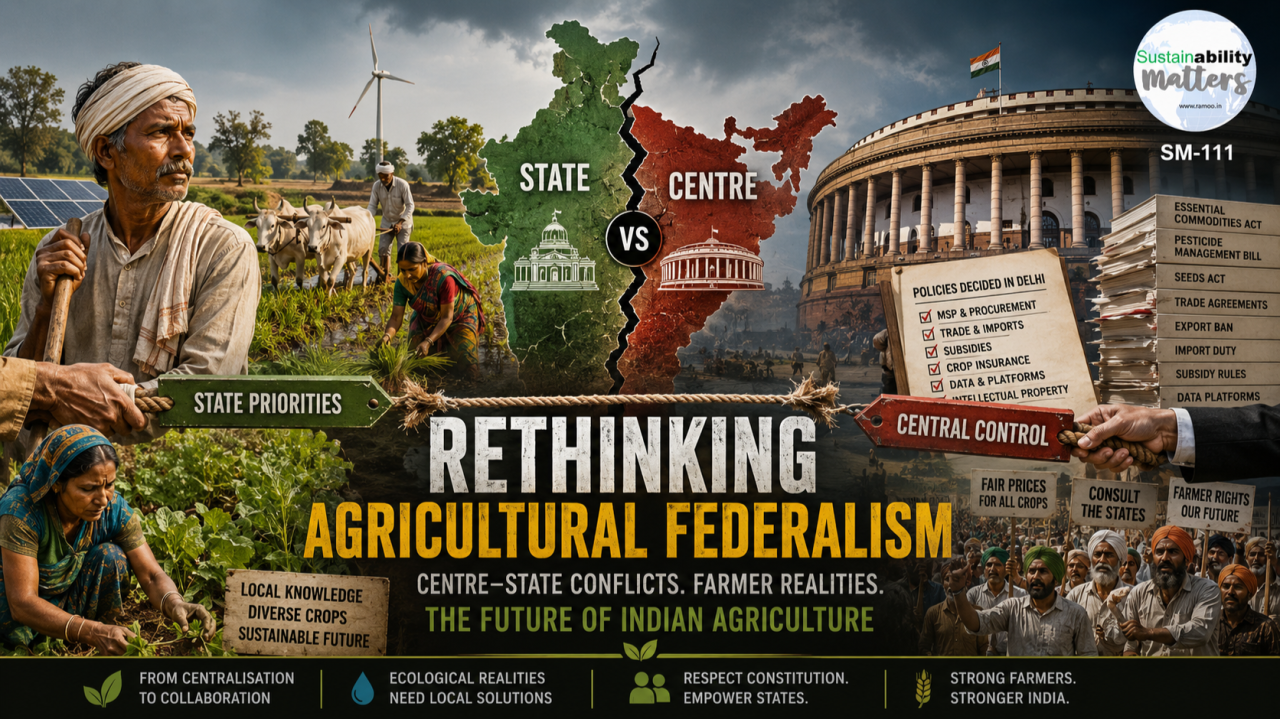
A constitutional, political-economy and rural governance question.
“India’s agricultural crisis is not merely ecological or economic. It is also constitutional.”
I. The Paradox at the Heart of Indian Agriculture
In the constitutional architecture of independent India, agriculture was placed firmly in the State List. Entry 14 of List II of the Seventh Schedule gives States exclusive legislative competence over “agriculture, including agricultural education and research, protection against pests and prevention of plant diseases.” Entry 18 gives them land, tenures, transfer of land, land improvement and agricultural loans. Entry 17 gives them water, subject to Entry 56 of the Union List. Entry 28 gives them markets and fairs. The framers of the Constitution, having lived through famine, zamindari and the violent agrarian disruptions of the colonial economy, understood something elementary: farming is local. Soils, rainfall, cropping cycles, tenancy patterns, caste structures, water tables and seed cultures vary not merely between States but between districts within a State. Centralised farm policy would be agronomic absurdity.
And yet, eight decades after Independence, the Union government decides the minimum support price of paddy, states, commodities and quantities for procurement, the import duty on pulses, the registration of pesticides, the release of genetically modified events, the architecture of fertiliser subsidy, the design of crop insurance, the rules of agricultural trade, the format of farmer databases, the carbon protocols for soil credits, and the conditionalities of centrally sponsored schemes that bind State agricultural budgets to Union priorities. Rarely any of these are discussed with the states. States, by contrast, are increasingly reduced to delivery agencies — implementing Union schemes through Union templates with Union branding, while bearing the ecological costs of decisions made in Krishi Bhavan and Vanijya Bhavan.
Tthe contradiction is not incidental. It is structural. The original constitutional placement of agriculture in the State List has been quietly hollowed out — not by amendment, but by accretion. Trade powers, concurrent entries, essential commodities legislation, treaty obligations under the World Trade Organisation, fiscal centralisation through the Goods and Services Tax, and the proliferation of conditional central schemes have together produced what may be called de facto centralisation without constitutional amendment. The legal text says agriculture is a State subject. The operational reality says otherwise.
To understand why this matters — and what to do about it — we must travel through constitutional doctrine, post-Independence policy history, the field realities of seed regulation and pesticide bans, the politics of MSP and subsidy, the global pressures of trade and intellectual property, and the ecological emergencies of groundwater, soil and climate. The destination is a proposal: that India needs a new conversation about agricultural federalism, and possibly a Sarkaria-style Commission to conduct it.
II. The Constitutional Foundations and Their Quiet Erosion
The Seventh Schedule: What the Text Promises
The Constitution of India distributes legislative power across three lists. The Union List (List I) enumerates 97 subjects on which only Parliament can legislate. The State List (List II) enumerates 66 subjects on which only State legislatures can legislate. The Concurrent List (List III) enumerates 47 subjects on which both can legislate, with Union law prevailing in case of conflict by virtue of Article 254.
Agriculture, in this architecture, sits emphatically with the States. Beyond Entry 14 (agriculture), Entry 18 (land), Entry 28 (markets) and Entry 30 (money-lending and agricultural indebtedness) are all in the State List. Animal husbandry, fisheries, water, public health and sanitation, local government — all the elements that together constitute rural life — are with the States. This was a deliberate choice. The Constituent Assembly debated and rejected the proposal that agriculture be placed in the Concurrent List. K.M. Munshi and others argued for federal supremacy; the agrarian voices, led by members from cultivating constituencies, prevailed. Agriculture was to be a State subject because Indian agriculture was — and is — plural.
The Concurrent and Union Levers: How Centralisation Walked In
The Constitution’s designers, however, also recognised that some agricultural matters could not be hermetically sealed within State borders. Entry 33 of the Concurrent List, as amended in 1954, includes “trade and commerce in, and the production, supply and distribution of” foodstuffs, including edible oilseeds and oils; cattle fodder; raw cotton and cotton seed; and raw jute. This single concurrent entry has become the constitutional doorway through which the Union government has walked into nearly every domain of agricultural policy. The Essential Commodities Act, 1955, enacted under Entry 33, allows the Centre to control production, supply, distribution, price and trade of any commodity it declares essential. Stock limits, movement restrictions, export bans, price controls — all flow from this provision.
Entry 41 of the Union List gives the Centre jurisdiction over foreign trade. Entry 42 covers inter-State trade and commerce. Entry 52 covers industries declared by Parliament to be in the public interest — a clause used to bring fertilisers, seed, pesticides, sugar, and food processing within central control. Entry 14 of the Union List gives the Centre power to enter into treaties — and Article 253 permits Parliament to legislate for the implementation of any treaty, even on subjects in the State List. The Patents Act amendments to comply with TRIPS, the Plant Varieties Protection Act, the Biological Diversity Act — each of these was anchored in Article 253 power, overriding the State List placement of agriculture.
The Finance Commission allocates devolution; the Union retains discretionary grants. The Goods and Services Tax, since 2017, has dissolved the residual fiscal autonomy of States. The cesses and surcharges that the Union levies sit outside the divisible pool, so even as overall taxation has expanded, the share that reaches States has shrunk. And the centrally sponsored schemes that nominally fund State agriculture — PM-KISAN, PMFBY, PM-KUSUM, the Soil Health Card programme, the National Mission on Natural Farming — come with such tight design templates that States that wish to redesign them to fit local agroecological realities find themselves penalised through reduced allocations.
The Judicial Record: Federalism as Doctrine, Centralisation in Practice
The Supreme Court has long held, beginning with State of West Bengal v. Union of India (1963) and reiterated in S.R. Bommai v. Union of India (1994), that federalism is part of the basic structure of the Constitution. In Bommai, the Court framed federalism as a feature beyond ordinary amendment. Yet the same judiciary has consistently upheld central legislation on agriculture-adjacent matters — from the Essential Commodities Act to the Forest Conservation Act to the central monopoly over inter-State river water allocation. The courts have read Concurrent and Union entries generously and State entries narrowly when conflict arises, on the doctrine of pith and substance and the canon that residuary power lies with the Union under Article 248.
In ITC Limited v. Agricultural Produce Market Committee (2002), the Court drew careful lines between regulation of agricultural markets (State) and the regulation of trade in agricultural commodities once they leave the farm gate (often Concurrent or Union). The line is intellectually defensible but practically corrosive: it means the moment a farmer’s produce becomes a marketable commodity, it slips into a regulatory domain where the Centre has the upper hand. The farmer is constitutionally a State subject; the farmer’s produce is increasingly a Union concern.
“Cooperative federalism”, the phrase that has dominated official discourse since the late 1990s, has come to function less as a description and more as an alibi. In practice, cooperation has frequently meant States accepting Union templates in exchange for funds, or remaining silent on Union initiatives that affect their constitutional turf because political alignment with the ruling party at the Centre is more rewarding than the assertion of jurisdictional autonomy. Cooperative federalism has, in this sense, become a euphemism for administrative centralisation.
III. From Nation-Building to Centralisation: A Brief Historical Itinerary
Phase I: Food Security and the Cooperative Imagination (1947–1965)
The first two decades after Independence were marked by a genuine federal pluralism in agriculture. The Community Development Programme, launched in 1952, was a national initiative, but its operational logic was decentralised: block-level development officers worked with village panchayats, agricultural extension officers and cooperatives. Land reforms — abolition of intermediaries, tenancy reforms, ceiling laws — were enacted by State legislatures, with the Centre providing constitutional cover through the Ninth Schedule. Kerala’s 1957 land reform legislation, West Bengal’s Operation Barga in the late 1970s, and Karnataka’s land reform of 1974 all reflected distinct State imaginations of agrarian justice.
Cooperatives, too, were imagined as State institutions. The Reserve Bank of India’s All-India Rural Credit Survey of 1954 recommended cooperative credit as the spine of rural finance, and States built primary agricultural credit societies, district central cooperative banks, and State cooperative banks under their own legislation. The architecture was federally diverse: Maharashtra’s sugar cooperatives, Gujarat’s dairy cooperatives, Punjab’s marketing cooperatives all developed distinctive institutional logics rooted in regional political economies.
This phase had its failures — the famine of 1965–67, the dependence on PL-480 wheat from the United States, the political humiliation of food aid conditionality. But its constitutional disposition was correct. Agriculture was being practised, regulated and reformed primarily by States, with the Centre playing a coordinating and resource-aggregating role.
Phase II: The Green Revolution and the Centralisation of the Plate (1965–1990)
The Green Revolution changed everything. The introduction of high-yielding varieties of wheat and rice from CIMMYT and IRRI required a centralised input supply system: dwarf seeds released through the Indian Council of Agricultural Research, fertilisers manufactured through public sector units under Union control, irrigation infrastructure financed by central plan allocations, and — critically — a price guarantee through the Minimum Support Price administered by the Commission for Agricultural Costs and Prices, with procurement by the Food Corporation of India.
Each of these instruments was constitutionally defensible. MSP was a price policy, exercisable under Entry 33. Procurement was foodstuff regulation. Fertiliser was an industry under Union control. But cumulatively, they produced a structural shift: the Centre now decided what was profitable to grow, where the inputs came from, and where the produce went. State agriculture departments, which had been the principal architects of cropping pattern in the 1950s, became extension agencies for a centrally designed system. Punjab grew wheat-paddy because the procurement system rewarded wheat-paddy. Andhra Pradesh’s coastal districts grew paddy because of the same logic. Pulses, millets, oilseeds — the crops with greater agroecological fit for many regions — receded because the price signal favoured the Green Revolution duo.
By 1980, the cereal-centric monoculture had locked in. Groundwater began to fall in Punjab. Soil organic carbon began to decline across the Indo-Gangetic Plain. The fertiliser subsidy bill began to balloon. Each of these consequences was a State-level ecological cost; each of the original decisions had been Union-level.
Phase III: Liberalisation and the Treaty State (1991–2010)
The 1991 reforms and the 1995 accession to the WTO opened a new chapter. The Agreement on Agriculture committed India to reductions in trade-distorting domestic support, tariff bindings, and market access. TRIPS required India to provide intellectual property protection for plant varieties — leading to the Protection of Plant Varieties and Farmers’ Rights Act, 2001. The Cartagena Protocol on Biosafety led to the Genetic Engineering Approval Committee being restructured. Each of these instruments was an Article 253 exercise: international treaty obligations overriding the State List placement of agriculture.
The Seeds Bill of 2004, which underwent multiple changes and still remained as draft after over 20 years, was justified on the ground that India needed a unified seed regulatory regime to honour its international obligations and to attract investment in the seed sector. States like Andhra Pradesh, which had already enacted strong seed regulation — the AP Seed Regulation Act of 2004 — were told that they should hold back because a national law was forthcoming. The national law took nearly two decades to mature. In the intervening regulatory vacuum, farmers in Andhra Pradesh suffered repeated crop failures from spurious cotton seeds, with no effective recourse against corporate suppliers. The federal architecture, in this case, failed not by acting wrongly but by failing to act.
Trade policy moved decisively to the Centre. Export bans on rice, wheat, sugar and onions — imposed unilaterally and often without notice — became standard tools of food price management. The political logic was urban consumer-focused; the economic cost was borne by States with marketable surpluses. Maharashtra’s onion farmers, Andhra Pradesh’s rice farmers, Uttar Pradesh’s sugarcane farmers — each periodically faced sudden export prohibitions or stock limits that wiped out anticipated returns. The State governments concerned were rarely consulted.
Phase IV: Digital Centralisation and the Scheme State (2010–2026)
The most recent phase has seen a new form of centralisation: digital and programmatic. PM-KISAN, launched in 2019, delivers direct income transfers of ₹6,000 per year to land-owning farmers, bypassing State governments entirely through Aadhaar-linked direct benefit transfer. The Agriculture Infrastructure Fund, the National Beekeeping Mission, the Per Drop More Crop programme, the Soil Health Card scheme, the National Mission on Natural Farming — each follows a similar template: Union design, Union branding, Union digital infrastructure, State implementation.
Agristack, the Union’s digital public infrastructure for agriculture, will federate farmer identities, land records, soil data, weather data and credit histories into a single Union-managed architecture. The constitutional implications are profound. Land records are a State subject; farmer identification is a State concern; cropping data is collected by State revenue and agriculture departments. Yet the federated digital architecture being built places the Union in the position of platform owner, with States as data contributors. The three farm laws of 2020, repealed after a year of farmer protest, were the most visible eruption of this centralising tendency. The laws sought to override State APMC legislation, to permit contract farming under a Union framework, and to amend the Essential Commodities Act — each provision constitutionally defensible under Concurrent List entries, each politically unacceptable to States that had not been consulted.
IV. Federalism Tested: Three Case Studies in Agricultural Governance
Case Study 1: Seed Regulation and the Andhra Pradesh Experience
In 2003 and 2004, large tracts of cotton in Andhra Pradesh’s Warangal, Karimnagar and Adilabad districts failed catastrophically. The cause was multiple: bollworm attack on Bt cotton hybrids that did not perform as advertised, spurious seed sold by unscrupulous dealers, and weather stress. Farmers, many of them indebted to private moneylenders, faced ruin. Suicide rates in Warangal climbed to among the highest in the country. The State government, then led by Dr. Y.S. Rajasekhara Reddy, attempted to act. A draft legislation, the Andhra Pradesh Seed Bill, was prepared. It would have created a State-level mechanism for testing seed quality, holding companies accountable, and compensating farmers for crop loss attributable to seed failure.
The Centre’s response was instructive. Officials of the Department of Agriculture and Cooperation argued that a national Seeds Bill was under preparation and that State legislation would create regulatory confusion. The State was urged to hold back. The Bill never moved. The Seeds Bill, 2004, languished in Parliament for nearly two decades. In the intervening period, farmers in Andhra Pradesh, Maharashtra, Karnataka, Telangana and elsewhere continued to be sold uncertified, mislabelled, or under-performing seeds, with no statutory remedy. The Seeds Act of 1966, designed for an era of public sector seed supply, was wholly inadequate for the post-liberalisation private seed economy. In case failure farmers have to approach consumer court as there are no provisions for compensation in the seed act. Yet States could not legislate, because the Centre had announced its intention to legislate. Haryana, Punjab and Telangana also tried in the last five years to make such legislations but failed.
This is the classic federal failure: the Centre asserts pre-emptive jurisdiction, fails to act, and leaves States with neither legislative authority nor policy outcomes. The constitutional position is even more peculiar: seeds are not explicitly listed in any of the three lists, but seed regulation has been treated as flowing from the Union’s Agriculture Industry, trade and commerce powers and from Entry 33 of the Concurrent List. The original State List placement of “protection against pests and prevention of plant diseases” — a provision that arguably covers seed quality — has been read down to insignificance.
Case Study 2: Pesticide Regulation, Endosulfan and Monocrotophos
The Insecticides Act, 1968, is central legislation enacted under the Union’s industry and trade powers. It establishes the Central Insecticides Board and the Registration Committee, which decide which pesticides may be manufactured, imported and sold in India. State governments’ powers under Section 27 of the Act are limited: they may prohibit the sale, distribution or use of an insecticide in their State for a period not exceeding sixty days at a time, extendable to a maximum of ninety days, where they are satisfied that such use is likely to cause risk to human beings or animals.
Ninety days. That is the constitutional and statutory window available to a State government to protect its own population from a hazardous chemical. After ninety days, the State must either let the chemical resume circulation or persuade the Centre to extend the ban nationally. The asymmetry is staggering. The State that bears the public health burden — the hospital admissions, the chronic neurological damage, the farmer suicides by deliberate ingestion — cannot make a durable decision to prohibit. The Centre, which is geographically and institutionally distant from the affected populations, holds the permanent regulatory authority.
The endosulfan tragedy in Kasaragod, Kerala, where aerial spraying on cashew plantations over two decades caused severe congenital deformities, neurological disorders and cancers among local populations, exemplified this asymmetry. Kerala banned endosulfan in 2001. The Centre took another decade — and a Supreme Court intervention in 2011 — to impose a national ban. In the interim, States like Karnataka and Andhra Pradesh continued to permit its use, because the Centre had not acted and they had not been similarly affected. A State with a public health emergency had no constitutional means to compel a national response.
Monocrotophos, an organophosphate that has been banned in over sixty countries, remains registered in India. Andhra Pradesh and Telangana farmers in cotton-growing districts have suffered acute poisoning episodes, developed pesticide resistance in pest populations, and used it as the agent of choice for suicide by ingestion. The Anupam Verma Committee in 2015 recommended banning monocrotophos, among twelve other pesticides; the Centre has acted on some but not all. States that wish to ban hazardous pesticides faster than the Centre is willing to find themselves constitutionally stuck.
The Pesticide Management Bill, introduced in 2008 and reintroduced in 2020, would centralise pesticide regulation further. It actually mentions The proposed Central Pesticides Authority would absorb most functions, leaving States with little more than the ninety-day emergency provision. The argument is administrative efficiency and international harmonisation. The cost is local sovereignty over local poisons.
Case Study 3: Women Farmers, Tenancy and the Andhra Pradesh Attempt
Between 2005 and 2007, the Andhra Pradesh government attempted a constitutional and institutional experiment of considerable ambition. The state had observed that women, who performed the bulk of agricultural labour in tenant farming households, were almost entirely invisible in the formal legal architecture. They held no land titles, no leases, no credit eligibility. When their husbands migrated, died or fell sick, they continued to till the land but had no juridical relationship to it. They could not access institutional credit because they had no collateral. They could not access input subsidies because they were not registered farmers. They could not access crop insurance because they had no insurable interest.
The proposal was to modify the State’s tenancy laws to allow women self-help group federations to lease land on behalf of their members, with State-backed guarantees against default. The arrangement would create a legally recognised tenancy in the name of a women’s collective; the collective would on-lease to individual women members; the State would underwrite the risk so that landowners would be willing to lease in formal terms rather than informal sharecropping. It would give women farmers a documentable agricultural identity — the gateway to credit, insurance, subsidy and extension services.
The proposal foundered on multiple federal contradictions. The bill was sent for approval to centre and it was turn down. The Andhra Pradesh proposal was, in effect, attempting a State-level institutional innovation in a regulatory environment where the supporting financial and administrative architecture was Union-controlled. The proposal was eventually shelved.
Kerala’s Kudumbashree mission later evolved a partial workaround through informal contract-based arrangements that did not require statutory tenancy reform — but at the cost of remaining in the grey zone of informal contracts, vulnerable to disputes and lacking the full juridical weight of formal tenancy.
The case illustrates a deeper point. State innovation in agriculture frequently runs aground not on the explicit prohibition of central law but on the implicit infrastructure of central regulation — banking norms, insurance rules, database formats, audit standards, subsidy templates. A State may have the legislative power to act, but lack the financial and administrative ecosystem in which the action would be meaningful. Federalism, in this sense, is not only a question of who can legislate. It is a question of who controls the operational substrate of policy.
V. MSP, Subsidies and the Distortion of Agroecological Choice
The Minimum Support Price system, the procurement architecture of the Food Corporation of India, the fertiliser subsidy paid to manufacturers under the Nutrient-Based Subsidy and the urea pricing scheme, and the centrally sponsored crop insurance under PMFBY together constitute the principal economic incentives that shape Indian cropping patterns. Each of these instruments is operated by the Union government. Each of them produces ecological consequences that are absorbed by the States.
Consider paddy in Telangana. The crop is grown across nearly four million hectares of largely irrigated land, much of it sustained by groundwater pumped from rapidly depleting aquifers using subsidised or free electricity provided by the State government. The procurement is by the Food Corporation of India at the MSP set by the Union. The water is from the State’s aquifers. The power is from the State’s exchequer. The procurement payment is from the Union. The ecological depletion, when it manifests as dried borewells, salinised soils and declining yields, will be borne by Telangana farmers and Telangana taxpayers.
The State has no jurisdiction over the MSP that creates the incentive to grow paddy. It has limited jurisdiction over fertiliser pricing that subsidises the urea on which paddy depends. It cannot redesign the procurement to prefer millets, even though millets would be agroecologically superior for Telangana’s rainfall and soil profile. It cannot redirect the Union’s subsidy outlay toward inputs more suited to its agroecology, because the subsidy is a Union expenditure on a Union-defined commodity basket.
PM-KISAN, the direct income transfer of ₹6,000 per year per land-owning farmer, is constitutionally a Union scheme using Union funds, justifiable under the residuary power and the broader social welfare clause. But it is distributed identically across States, regardless of agroecological context, farm size, or actual cultivation. A landowner with a hundred acres in Punjab and a marginal farmer with half an acre in Jharkhand receive the same transfer per landholding. A State that wished to top up the transfer for marginal farmers, or to add an agroecological conditionality — say, an additional payment for farmers practising natural farming or growing millets — would have to do so from its own resources without disturbing the Union scheme. The federal system permits parallel action; it discourages integrated redesign.
Crop insurance under PMFBY is similarly designed at the Union level, implemented by private insurers selected through Union processes, with premium subsidies shared between Union and State. States that wished to redesign coverage — say, by including weather-indexed insurance for rainfed millets or by extending coverage to tenants without land title — have had to negotiate within tight Union templates. Telangana, Gujarat and Bihar’s decision to exit PMFBY in 2018 was an exercise of federal autonomy, and the cost to be borne by the state was high.
The distortion is systemic. The Centre sets prices, subsidies and templates. States bear ecological consequences and political accountability. The farmer, caught in this asymmetry, knows only that the system rewards certain crops and certain practices, even when their soil, water and climate are telling them otherwise.
VI. The Political Economy of Fiscal Centralisation
The architecture of fiscal federalism was designed, through Article 280 and the Finance Commission, to balance Union and State revenues. The Fifteenth Finance Commission recommended that 41 per cent of the divisible pool of central taxes be devolved to States. In practice, however, the divisible pool itself has shrunk relative to total Union revenue. Cesses and surcharges, which sit outside the divisible pool, have grown from around 11 per cent of gross Union tax revenue in 2011–12 to over 20 per cent in recent years. This means that even as the formal devolution share has remained roughly constant, the absolute amount reaching States has lagged the growth in Union revenue.
Goods and Services Tax, since 2017, has consolidated this trend. States surrendered their independent authority to tax sales of goods, in exchange for a constitutionally guaranteed compensation for revenue shortfalls for five years. That compensation period ended in 2022, after which States have had to absorb shortfalls. The GST Council, the constitutional body that decides rates, has formal Union and State representation, but its voting structure gives the Union an effective veto.
Centrally sponsored schemes have proliferated in this fiscally constrained environment. Their share in total Union expenditure has grown, and the conditionalities attached to them — design templates, branding requirements, financial monitoring norms, evaluation criteria — have tightened. A State that accepts a centrally sponsored scheme accepts its design. A State that rejects the design forgoes the funds.
The political asymmetry that follows is unmistakable. States politically aligned with the ruling party at the Centre tend to receive timely releases, additional discretionary allocations, and favourable scheme adaptations. States in political opposition tend to face delayed releases, audit objections, and tighter compliance scrutiny. This is not a unique pathology of any one ruling dispensation; it has been a feature of central–State relations across decades. But it has intensified as the share of conditional transfers has grown.
Agriculture, with its dependence on centrally sponsored schemes for irrigation, soil health, mechanisation, organic farming, horticulture, animal husbandry, fisheries and farmer welfare, is particularly exposed to this asymmetry. A State that wishes to prioritise agroecological transition over Green Revolution intensification may find that the bulk of available scheme funds are tied to fertiliser-intensive, irrigation-intensive Union templates. The State can implement its preferred priorities only from its own residual fiscal space — the space that GST and cesses have shrunk.
VII. The Constitutional Paradox of Agricultural Trade
Perhaps the sharpest expression of the constitutional contradiction is in the domain of agricultural trade. Agriculture is a State subject. Trade in agricultural commodities is a Union subject. Therefore: the production of paddy is governed by State law, but the export of rice is determined by the Directorate General of Foreign Trade. The cultivation of onion is regulated by Maharashtra; the export of onion is regulated by Vanijya Bhavan. The growing of wheat is a State concern; the import of wheat is a Union concern.
This bifurcation has produced repeated trauma for farmers. In 2007–08, in 2010, in 2019, and again in 2023, sudden export bans on rice and wheat were imposed by the Centre in response to domestic price pressures, without consultation with the State governments whose farmers had planned production in anticipation of export markets. In 2023, the export ban on broken rice and the imposition of duty on parboiled rice abruptly contracted the demand for paddy in Andhra Pradesh, West Bengal and Punjab. The State governments were informed, not consulted. The farmers were affected, not compensated.
Imports follow the same pattern. The reduction in import duties on pulses, ostensibly to control consumer inflation, has at various points undermined the price realisations of pulse farmers in Maharashtra, Madhya Pradesh and Karnataka. The recent surge in edible oil imports has rendered domestic oilseed production economically marginal across States that once had thriving groundnut and sunflower economies. Each of these decisions was constitutionally a Union prerogative under Entry 41. Each of them altered the economic landscape of agriculture in States that had no say in the decision.
Free trade agreements compound the issue. The bilateral agreements with ASEAN, Japan, Korea, and more recently the proposed agreements with the United Kingdom, the European Union and the United States, all carry implications for agricultural tariffs, sanitary and phytosanitary standards, geographical indications, and subsidies. None of these agreements has been negotiated with formal State participation. The Ministry of External Affairs, the Ministry of Commerce and the Ministry of Agriculture conduct the negotiations; the State agriculture and trade departments are informed of the outcomes.
The three farm laws of 2020 were the most visible eruption of this trade-versus-production tension. The Farmers’ Produce Trade and Commerce (Promotion and Facilitation) Act, the Farmers (Empowerment and Protection) Agreement on Price Assurance and Farm Services Act, and the Essential Commodities (Amendment) Act sought to create a national agricultural market by overriding State APMC laws, to permit contract farming under a Union framework, and to remove stock limits on a range of commodities. Each of these provisions could be defended under Concurrent List entries on trade and commerce in foodstuffs. None of them had been preceded by the kind of structured federal consultation that would befit a redesign of the agricultural economy of a billion people.
The laws were repealed in November 2021 after a year of farmer protest. The constitutional question they raised — whether the Centre can, through Concurrent List trade powers, restructure the agricultural marketing systems that States have built under Entry 28 of the State List — remains formally unresolved. The political answer is clear: it cannot do so unilaterally and survive. The legal answer is unsettled.
VIII. Ecological Federalism and the Coming Crises
Indian agriculture confronts ecological pressures whose scale has no historical precedent. Aquifers are falling across the western and southern peninsular regions. Soil organic carbon has declined to under 0.5 per cent across vast tracts of the Indo-Gangetic Plain. Heat stress is reducing wheat yields. Erratic rainfall is making rainfed farming, on which two-thirds of Indian agriculture depends, increasingly precarious. Biodiversity in cultivated landscapes has collapsed. Pollinator decline is now measurable. Antibiotic and pesticide residues in food chains are above safety thresholds in multiple recent studies.
Each of these crises has both national and local dimensions. National policy frames — climate adaptation strategies, soil health missions, water conservation programmes, agroecological transition plans — are necessary. Local agroecological responses — region-specific cropping system reform, traditional seed conservation, watershed-based water management, panchayat-led biodiversity protection — are equally necessary. The architecture of agricultural federalism should ideally allow these two levels to reinforce each other.
In practice, the architecture tilts toward national framing. The National Mission on Sustainable Agriculture, the National Mission on Natural Farming, the National Adaptation Fund for Climate Change in Agriculture — each is designed at the Union level, with broad templates that States adapt at the margins. The locally specific knowledge — of seed varieties, of pest cycles, of soil moisture regimes, of pollinator networks — that ought to drive agroecological transition is precisely the knowledge that resides in farmers, panchayats, agricultural universities and State-level agencies. It is not the knowledge that is most easily captured in central scheme guidelines.
Water is the most striking instance. Water is a State subject under Entry 17, subject only to the Union’s power over inter-State river regulation under Entry 56. Yet groundwater — the source of nearly two-thirds of irrigation in India — is governed by State legislation in only a handful of States, and that legislation is often weak or unenforced. The Centre’s influence on water-using crops, through MSP and procurement, is enormous. The State’s influence on water itself, through electricity pricing for pumping, is also enormous. Yet there is no formal federal coordination on water-crop economics. Punjab’s groundwater collapse is a State emergency made out of Union pricing signals.
Biodiversity, similarly, is governed by the Biological Diversity Act, 2002 — a Union law enacted under Article 253 to implement the Convention on Biological Diversity. The Act establishes State Biodiversity Boards and Biodiversity Management Committees at the panchayat level, but the effective regulatory authority is centralised. State-level seed networks like the Apna Beej initiatives, which work to keep traditional varieties in farmer hands and out of corporate proprietary registers, operate in an awkward space between State agriculture departments and Union biodiversity regulation.
A serious response to ecological pressures would require what may be called ecological federalism: a constitutional and institutional architecture that recognises ecological systems as locally specific and devolves regulatory authority accordingly, while retaining national coordination on cross-boundary issues. India has the constitutional vocabulary for such an architecture — the Seventy-Third Amendment’s panchayati raj provisions, the Sixth Schedule’s tribal area provisions, the State List entries on agriculture and water. It does not, at present, have the political will or institutional design to assemble them into a coherent ecological federalism.
IX. Comparative Perspectives: How Other Federations Manage Agriculture
India is not alone in confronting the tension between national food policy and regional agricultural diversity. Most federations have evolved their own balances; none has solved the problem definitively. A brief comparative survey is instructive.
In the United States, agriculture sits in an unusual constitutional position. The federal government regulates interstate commerce in agricultural commodities, provides crop insurance, sets the Farm Bill that defines support payments, and negotiates trade. States retain authority over land use, water rights, food safety standards above the federal minimum, pesticide use beyond federal labels, and agricultural research. California’s authority to set pesticide and food safety standards stricter than the federal Environmental Protection Agency norms is well established, and has driven national tightening through what is sometimes called the California effect. Water rights in the western states are governed by state-specific doctrines of prior appropriation. Federal pre-emption is contested in court regularly. The American system tolerates considerable regulatory pluralism.
Brazil presents a different pattern. The 1988 Constitution gives the federal government strong powers over agricultural credit, land reform, and rural policy. States and municipalities exercise authority over land use planning, environmental licensing, and local agricultural extension. The federal Embrapa research network is national, but State agricultural research organisations like Epagri in Santa Catarina or IAC in São Paulo retain considerable autonomy. The most distinctive feature is the role of the Movimento dos Trabalhadores Rurais Sem Terra and other agrarian movements in shaping federal–State policy negotiations, which gives a measure of social federalism even where formal federalism is centralised.
The European Union’s Common Agricultural Policy is perhaps the most centralised agricultural regime among large federations. Agricultural payments, market regulation, and rural development are decided at the EU level. Member states implement, with some flexibility in the second pillar on rural development. Yet within member states, particularly federal ones like Germany or quasi-federal ones like Spain, regional authorities retain significant powers over land use planning, agroecological standards, and regional product designations. The EU shows that even highly centralised federations can preserve regional agricultural diversity through institutional design — protected designations of origin, regional rural development programmes, geographical indications.
Australia presents an interesting contrast. The Commonwealth has limited direct authority over agriculture; most production and land use regulation rests with the States and Territories. Federal involvement comes through trade, biosecurity, research funding through CSIRO, and inter-jurisdictional water management like the Murray-Darling Basin Plan. The 2007 Water Act, which created a national framework for water sharing in the basin, is one of the rare examples of substantive federal agricultural legislation. The Australian system suggests that strong State autonomy in agriculture is compatible with effective national coordination, provided the coordination is built through inter-governmental agreement rather than unilateral pre-emption.
China is not a federation, but its centre–province dynamics in agriculture are worth noting. The central government sets grain self-sufficiency targets, provides input subsidies, manages strategic reserves, and conducts trade. Provinces have considerable autonomy in implementation, in setting local cropping patterns, and in piloting agricultural innovations — the Household Responsibility System of the late 1970s began as a provincial experiment. China demonstrates that even in a unitary state, agricultural diversity can be accommodated through administrative decentralisation, provided central political authority is willing to permit experimentation.
The lessons for India are not about adopting any single foreign model. They are about recognising that the question of agricultural federalism is universal, that the institutional answers vary widely, and that the Indian solution must be developed indigenously, drawing on its own constitutional architecture, agrarian traditions, and political culture.
X. Reimagining Agricultural Federalism for India@100
If the diagnosis of the preceding sections is correct — that Indian agriculture suffers from a structural mismatch between constitutional placement in the State List and operational centralisation through Union instruments — then the response must be structural. Incremental adjustments will not suffice. The mismatch has accumulated over seven decades and will not be undone by another scheme guideline.
The proposal advanced here is a fundamental rethinking of agricultural federalism, framed by a new institutional process and operationalised through several specific reforms. The framing is one of cooperative federalism in its substantive rather than rhetorical sense — federalism that genuinely cooperates, that respects constitutional placements while building national coordination, that recognises ecological and cultural diversity while ensuring national food security.
A New Commission on Agricultural Federalism
The first proposal is institutional. India has had two major commissions on Centre–State relations: the Sarkaria Commission, which reported in 1988, and the Punchhi Commission, which reported in 2010. Neither was focused on agriculture, though both touched on related questions of fiscal federalism and concurrent jurisdiction. The time has come for a commission focused specifically on agricultural federalism.
Such a commission — call it the Agricultural Federalism Commission — should be constituted with representation from all States, with a mandate that explicitly includes the constitutional, fiscal, regulatory, and ecological dimensions of agriculture. Its terms of reference should cover the entire architecture: the Concurrent List entries that have been used to expand Union jurisdiction, the operation of the Essential Commodities Act, the design of centrally sponsored schemes, the negotiation of international trade agreements, the regulatory regimes for seeds, pesticides and biotechnology, the architecture of fiscal transfers, and the institutional framework for federal coordination.
The Commission should be empowered to recommend constitutional amendments where necessary, statutory changes, fiscal restructuring, and new institutional mechanisms. It should consult extensively with State governments, farmer organisations, agricultural scientists, and civil society. Its report should be debated in Parliament and in State legislatures, and its recommendations should drive a multi-year programme of federal redesign.
Constitutional and Statutory Clarifications
Several specific clarifications follow from the analysis. The Essential Commodities Act should be substantially reformed, with State concurrence required before the Centre imposes export or stock controls on agricultural commodities. The Insecticides Act should be amended to give States permanent authority to ban hazardous pesticides within their territory after due process, not merely a ninety-day emergency power. The Seeds Act should be redesigned with explicit State legislative competence over seed quality, accountability, and farmer compensation, with Union legislation limited to inter-State and international dimensions.
On international trade, no agricultural commitment in any treaty or trade agreement should be made without formal consultation with State governments through a constituted forum — an Agricultural Trade Council, perhaps, modelled on the GST Council but for agricultural trade policy. The consultation should not be merely informational; it should be substantive, with State governments having a documented opportunity to register concerns and have them addressed.
On centrally sponsored schemes, the principle should be that any scheme operating in a State List subject should be designed with State concurrence, should permit State adaptation within a defined corridor of flexibility, and should not be tied to branding or template requirements that undermine State institutional architecture. The Niti Aayog’s Governing Council, currently a consultative body, should be empowered as a substantive coordinating mechanism with documented decision-making processes.
Fiscal Decentralisation for Agroecological Transition
The fiscal architecture must be redesigned to support agroecological transition rather than to lock in cereal-centric intensification. This means several specific reforms. First, the fertiliser subsidy, currently around 1.7 per cent of GDP and paid almost entirely to manufacturers under Union schemes, should be progressively converted into a portable per-farmer agroecological transition payment that States can deploy according to local cropping priorities. The transition would take a decade; it would not be costless; but it would shift the economic incentive from urea to soil organic carbon, from monoculture to diversity.
Second, MSP should be reformulated to cover a broader basket of crops including millets, pulses and oilseeds, with State governments having authority to propose additions reflecting regional agroecological priorities. Procurement infrastructure should be diversified so that State agencies, FPOs and cooperatives can participate in procurement as per the state needs alongside the FCI, with Union financial support for the participation.
Third, the Finance Commission’s mandate should explicitly include the ecological costs and contributions of State agricultural systems. States whose agricultural systems sequester carbon, conserve groundwater, protect biodiversity, and maintain traditional seed systems should receive ecological fiscal transfers in recognition of the public goods they provide. The current architecture penalises States that do not maximise extractive intensification; the new architecture should reward States that practise regenerative agriculture.
Regional Food System Planning
The fourth pillar is regional food system planning. India’s agricultural diversity is best served not by a single national food policy but by a federation of regional food system plans, each calibrated to the agroecology, food culture, and economic structure of its region. The Eastern Ghats millet region, the Indo-Gangetic Plain, the Western Ghats spice region, the North-East shifting cultivation landscape, the arid Western India pulse region, the irrigated peninsular paddy belt — each is a distinct agroecological zone with distinct food production logic. National food security can be built as the aggregation of regional food systems, not as the imposition of uniform cropping patterns.
State governments, in collaboration with agricultural universities, panchayati raj institutions, and farmer producer organisations, should be supported to develop regional food system plans that integrate production, processing, storage, marketing and consumption. The Union’s role should be coordination, financing of inter-regional logistics and strategic reserves, regulation of inter-State trade, and management of international trade in alignment with the aggregate of regional plans.
From Command Federalism to Cooperative Federalism, Substantively
The deeper shift is cultural and political. India’s agricultural federalism has, over seven decades, drifted from the cooperative federalism of the early Republic to what might be called command federalism — a federalism in which the Centre commands and the States implement, in which Union templates are imposed and State adaptations are tolerated, in which national branding overrides regional institutional identity. This is not the federalism the Constitution envisaged. It is not the federalism that Indian agricultural diversity requires. It is not the federalism that India’s ecological future demands.
A return to substantive cooperative federalism requires three things. It requires political will at the Centre to share authority, not merely to delegate implementation. It requires institutional assertion by States of their constitutional position, including through litigation, legislative action, and inter-State coordination. And it requires civil society pressure — from farmer organisations, agricultural scientists, environmental groups, and informed citizens — to make agricultural federalism a public concern, not merely a technical question for administrators.
XI. Conclusion: The Constitutional Question at the Heart of the Crisis
The farmer who calls the Kisan Mitra helpline in Andhra Pradesh, who has lost her crop to spurious seed, who has been hospitalised by monocrotophos poisoning, who has watched her borewell run dry while paddy procurement signals tell her to grow more paddy, who has been excluded from PM-KISAN because the land title is in her absent husband’s name — she is at the receiving end of a federal architecture that has lost its constitutional coherence. The crisis she lives is presented as ecological, or economic, or technological, or administrative. It is all of those. But it is also, foundationally, a constitutional crisis.
Agriculture is a State subject in the text of the Constitution. In the practice of governance, it has become a Union concern in nearly every meaningful dimension. The gap between text and practice is filled with the suffering of farmers and the despair of State institutions that have been hollowed out from within. This gap cannot be closed by another scheme, another mission, another technological intervention, another digital platform. It can be closed only by a renewed constitutional conversation, conducted with the seriousness that the question deserves, leading to a redesign of agricultural federalism for the second century of the Indian Republic.
Its time for Agricultural Federalism Commission, for constitutional and statutory clarifications, for fiscal decentralisation supporting agroecological transition, for regional food system planning, for substantive cooperative federalism — is offered in that spirit. It is neither a call for States’ rights against the Union, nor a defence of Union authority against the States. It is a call for honest constitutional reckoning. India’s agricultural crisis is not merely ecological or economic. It is also constitutional. The Constitution itself, read with the seriousness its framers intended, offers the resources to address it. The question is whether the political will exists to read it again.
Recent Comments