
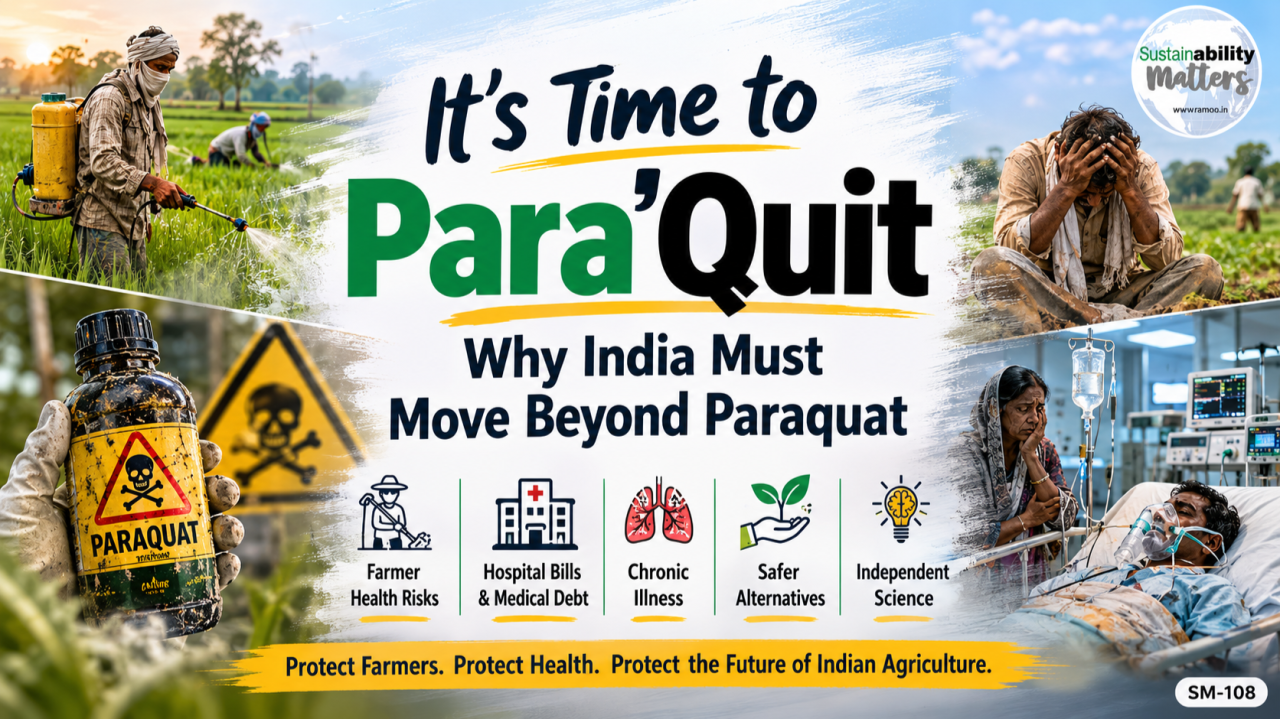
India needs a serious national conversation on paraquat — and more broadly, on the direction Indian agriculture is taking.
Paraquat is often defended as a “cheap and effective” herbicide. But cheap for whom?
The price a farmer pays at the shop counter is only the first installment of a much larger hidden cost. Later payments often come through hospital bills, medical shop expenses, chronic illness, damaged lungs, neurological disorders, and lifelong suffering borne silently by farming families.
More than 60 countries have already banned or severely restricted paraquat — including Switzerland, where its manufacturer Syngenta is headquartered. The World Health Organization classifies it as a Highly Hazardous Pesticide. Yet in India, where pesticide application is mostly manual, protective gear is impractical in high temperatures, and exposure risks are high, we continue to normalize its use.
What Indian hospital data actually shows
This is not a foreign problem we are importing through scare stories. Indian medical literature has been documenting paraquat deaths quietly, ward by ward, for over a decade. Read together, these studies tell a story that the agrochemical industry would rather we did not assemble.
A retrospective study from the Christian Medical College, Vellore — one of the most carefully done Indian series, published by Gunasekaran and colleagues in Indian Journal of Critical Care Medicine (2020) — followed 55 paraquat poisoning patients over five years. The in-hospital mortality rate was 72.7 percent. Acute kidney injury was the most common manifestation, present in over 80 percent of patients. Steroids and cyclophosphamide, the standard “rescue” therapies, did not reduce mortality. The authors state plainly that paraquat poisoning has no effective antidote.
A registry-based study from Kasturba Medical College, Manipal (Kanchan et al., Journal of Forensic and Legal Medicine, 2015) found that paraquat poisoning accounted for 14.4 percent of all poisoning fatalities during the study period. Manner of death was suicidal in 92.9 percent of cases. Half of the victims died within two days of consumption. The age range — 17 to 65 years — is essentially the productive working life of rural India.
A cross-sectional study at AIIMS Bhubaneswar (Indian Journal of Forensic and Community Medicine, 2020) drew its cases from Odisha and bordering districts of Chhattisgarh — regions where, the authors note, “crop failures and family disturbances often drive people to look for poison.” Postmortem findings repeated the now-familiar pattern: ulceration of the tongue and pharynx (the so-called “paraquat tongue”), respiratory failure, multi-organ damage.
The most recent Indian data is the most damning. A study from Gauhati Medical College and Hospital, Assam (Cureus, 2025) reviewed paraquat admissions between April 2024 and March 2025. Of 21 patients admitted, 19 died — a mortality rate of 90.47 percent. Most were women in their twenties from rural backgrounds. Every patient required ICU care and mechanical ventilation. Pulmonary fibrosis and ARDS were the leading causes of death.
A South Indian case series of 15 survivors (BMC, 2025) underlines the point in reverse: even those who lived had a mean age of just 24.6 years and were left with chronic gastrointestinal and pulmonary complications.
The pattern across Tamil Nadu, Karnataka, Kerala, Odisha, Assam, Telangana and Andhra Pradesh is consistent:
- mortality rates between 70 and 90 percent, depending on dose
- no effective antidote anywhere in the world
- death frequently within 48 hours from multi-organ failure, or weeks later from progressive lung fibrosis
- young rural adults disproportionately affected
The National Medical Journal of India carried an explicit editorial position in 2024 — Murthy Malla and Kattamreddy from Andhra Medical College, Visakhapatnam, titled “A case for banning paraquat in India: A public health concern.” When practising doctors begin writing public-health editorials calling for a ban on a product they are still being asked to treat, the system has already told us what it thinks.
The numbers we are not collecting
There is also an under-reporting problem. Dambal and colleagues, writing in NMJI in 2021, documented the reasons paraquat poisoning is systematically under-reported in India: deaths recorded as “OP poisoning” or “unknown poison” in hospital registers, no mandatory product-specific cause-of-death coding, and weak surveillance at the district level. The result is convenient for everyone except the families. The regulator can claim there is “no evidence of a problem.” The manufacturer can cite the absence of data. And the next farmer walks into the next shop and buys the same yellow liquid in the same plastic pouch.
Pesticide Action Network (PAN) India’s 2015 field report, Conditions of Paraquat Use in India, documented exactly the conditions every clinician now sees in casualty: paraquat sold in unlabelled plastic carry bags, sprayed without protective equipment, applied in temperatures where wearing PPE is physiologically impossible, and stored alongside drinking water in farmer homes.
The emetic that wasn’t
One detail from the NMJI 2024 paper deserves to be read slowly. Syngenta, the manufacturer, was aware of paraquat’s extreme toxicity and incorporated an emetic — coded as PP796 — into the formulation, ostensibly to make a poisoned person vomit before a lethal dose was absorbed. The quantity added, however, was less than what is required to actually induce emesis in humans. The emetic was added, in effect, for the regulatory file. Not for the farmer.
This is what the agrochemical industry calls “stewardship.” A product so toxic that the manufacturer privately accepts an antidote-grade defence is necessary — and then puts in a sub-therapeutic dose so the box can be ticked. An Indian weed scientist has reportedly proposed that paraquat be sold only in a pre-diluted, ready-to-spray form rather than as the 24 percent concentrate, which would at one stroke reduce both occupational exposure and the lethality of impulsive ingestion. Companies have rejected the suggestion citing higher transportation costs.
Transport costs versus farmer lives. The trade-off has been made; we are simply not told it has been made.
What the acute deaths miss: persistence, food, and the unborn
Acute hospital deaths are only the visible portion of the toll.
Soil and water persistence. Paraquat has a half-life of up to 20 years in soil. In water, half-lives have been reported anywhere from 2 to 820 years depending on sunlight and depth. It binds to suspended sediments, accumulates in the food chain, and shows the classic profile of a persistent organic pollutant.
Food residues. A study by Gupta and colleagues (Environmental Science and Pollution Research, 2022) on Pusa agricultural fields in Delhi found paraquat residues in wheat grains exceeding the 0.1 mg/kg threshold — and, crucially, the control crop, where no paraquat had been applied, also showed background residues at 3.1 mg/kg. Read that twice. Wheat that no farmer sprayed paraquat on was already carrying a residue load thirty times the regulatory limit, simply because of contamination of the agricultural environment around it.
Pregnancy and the foetus. Paraquat crosses the placenta. In documented cases of attempted suicide during pregnancy, paraquat levels in foetal blood have been found to be 4 to 6 times higher than in the mother’s blood. Analyses of cord blood, hair, and meconium have linked paraquat to organ toxicity and intrauterine foetal death. Pregnant women living near sprayed fields are exposed without ever touching a sprayer.
When we describe paraquat only by the rate at which it kills people who drink it, we are describing the smallest part of the harm. The larger story is that it does not leave — not the soil, not the water, not the grain, not the womb.
The Parkinson’s question
A growing body of epidemiological work, including the long-running NIEHS-funded Agricultural Health Study in the United States, has linked occupational paraquat exposure to Parkinson’s disease. Farmers who used paraquat developed Parkinson’s at roughly 2.5 times the rate of non-users. Indian epidemiology on this is thin, mostly because we do not look. That is itself a policy choice.
Cases reported across states
Beyond hospital case series, paraquat has surfaced repeatedly in news reports — and not only in connection with farming.
Kerala has been trying to be rid of paraquat for over a decade. Use was effectively stopped from 2011, and the state moved towards formal prohibition. In February 2022, the ban was revoked — a reminder that under the Insecticides Act, pesticide registration is a Union subject and state-level prohibitions sit on borrowed legal ground. The chemical then returned to the headlines through criminal cases: in 2022, the Sharon Raj murder case in Kerala saw paraquat used as a poisoning weapon; in early 2026, the death of actor Rahul Ramakrishna’s brother brought another paraquat case into public view.
Tamil Nadu and Karnataka continue to report a steady stream of admissions to tertiary hospitals, predominantly suicidal ingestion among young rural adults — and notably, in one Indian study, young illiterate people from non-farm backgrounds attempting impulsive self-harm with paraquat picked up over the counter. This is no longer only a farmer-occupational issue.
Odisha has long been a hotspot. The AIIMS Bhubaneswar series notes that paraquat is freely available in agricultural shops across districts where farmer distress is high.
Andhra Pradesh and Telangana have seen rising case counts. The Telangana government has now moved towards a state-level restriction — a precedent that should embarrass the Union government into national action rather than continued delay through the perpetually pending Pesticide Management Bill.
Assam and the Northeast show the dual face of the problem: tea plantations remain the historical context for paraquat exposure, and Gauhati Medical College’s data shows hospitals now receiving patients whose path from field to ward is direct and undeniable.
A litigation in the Supreme Court of India — seeking a prohibition on 99 hazardous pesticides including paraquat — has been pending for years. Public-health groups have argued, with considerable force, that Syngenta’s continued marketing of paraquat in Indian conditions violates the FAO/WHO International Code of Conduct on Pesticide Management, which restricts highly hazardous pesticides to use settings where appropriate protective equipment is genuinely available and worn. In Indian conditions, that test is not met. It cannot be met.
What other countries did — and what happened
The argument that “ban will hurt agriculture” is empirically false.
When South Korea banned paraquat in 2011, pesticide-suicide deaths per 100,000 people fell from 5.26 to 2.67 within two years. Taiwan, after prohibiting paraquat, recorded a 58 percent fall in paraquat suicides and a 37 percent fall in total pesticide suicides — meaning people did not, on the whole, simply substitute another poison. Sri Lanka‘s progressive restriction of highly hazardous pesticides, including paraquat, contributed to one of the steepest declines in suicide rates ever recorded in any country. The European Union banned paraquat in 2007. China, where it was once manufactured at scale, has phased it out for domestic use.
None of these countries collapsed agriculturally. Weeds did not win.
Banning paraquat does NOT mean reducing agricultural production
Indian farmers have long managed weeds using:
- inter-cultivation
- mulching
- crop rotation
- cover crops
- stale seedbed techniques
- mechanical weeding
- ecological weed suppression methods
Even today, many farming systems across India successfully reduce dependence on hazardous herbicides through integrated weed management approaches.
Paraquat is mainly used against annual grasses, broadleaf weeds, and mixed vegetation in plantations, orchards, bunds, and pre-plant situations. But every one of these situations has alternatives.
In rice systems, farmers can use stale seedbed methods, rotary weeders, and mechanical weed management.
In cotton and pulse systems, inter-row cultivation and cover cropping can significantly reduce weed pressure.
In tea, coffee, coconut, and horticultural systems, live mulches, slashing, mower-based weed control, and biodegradable mulches are already proven alternatives.
PAN UK’s review of paraquat alternatives lists living mulches, controlled grazing, mechanical weeding, and thermal weeding among non-herbicide replacements directly applicable to Indian conditions. Costs may rise — herbicide substitutes by perhaps two to ten times, non-herbicide methods more steeply at first — but with scale these decline, and in any case, as the NMJI authors put it, the additional costs associated with health impacts and lives lost due to paraquat far outweigh any potential savings. That sentence belongs in every cost-benefit analysis the Ministry of Agriculture undertakes.
The future cannot simply be replacing one dangerous chemical with another.
We need investment in farmer-centered alternatives:
- mechanical weeders
- custom hiring centres
- ecological weed management
- extension support
- soil-health based farming systems
The role of agricultural science
At the same time, we must honestly examine another worrying trend.
Many agricultural scientists and even some departments meant to serve farmers are increasingly behaving like celebrity endorsers and influencers for agrochemical products rather than independent generators of public knowledge.
The role of agricultural science is not to market chemicals. Its role is to critically evaluate them.
Scientists are meant to ask:
- What are the long-term health impacts?
- What are the ecological consequences?
- What are the hidden economic costs to farmers?
- Are there safer and more sustainable alternatives?
Instead, farmers too often receive one-sided messaging focused only on “efficacy,” “yield response,” and “quick control,” while occupational health risks, chronic exposure, biodiversity loss, and farmer indebtedness receive far less attention.
The Pusa wheat residue finding is a useful test. A high-profile public agricultural research station, on its own fields, found paraquat residues in wheat grains above the regulatory limit — and background contamination of 3.1 mg/kg even in unsprayed control plots. That is an agricultural science result. It should have been a national news story. It was a footnote in a journal.
When public institutions begin sounding like product promotion platforms, scientific credibility itself comes under threat.
Farmers do not need influencers.
They need independent, evidence-based, farmer-centered knowledge systems that place public health, ecological sustainability, and long-term resilience above commercial interests.
If governments subsidized chemical-intensive agriculture for decades, they can certainly support safer transitions now.
Conclusion
This debate is not just about weeds.
It is about public health, farmer dignity, rural safety, scientific integrity, and the future direction of Indian agriculture.
A herbicide for which 70 to 90 percent of poisoned patients die in Indian hospitals; for which there is no antidote; whose manufacturer added a deliberately sub-therapeutic emetic to clear regulatory hurdles; which contaminates wheat grain even on unsprayed fields; which crosses the placenta at concentrations several times higher than in the mother’s blood; which has been linked to Parkinson’s disease; which has been used as a murder weapon; and which has been banned by more than 60 countries — should not require further committees in India to reach a decision.
History will not judge us by how quickly we killed weeds.
It will judge us by whether we protected the people who feed the nation.
Selected references
- Murthy Malla BSS, Kattamreddy AR. A case for banning paraquat in India: A public health concern. Natl Med J India 2024; 37 (5): 270–1.
- Gunasekaran K et al. Paraquat Poisoning: A Retrospective Study of 55 Patients From a Tertiary Care Center in Southern India. Indian J Crit Care Med, 2020. (CMC Vellore series, 72.7% mortality)
- Kanchan T, Bakkannavar SM et al. Paraquat Poisoning: Analysis of an Uncommon Cause of Fatal Poisoning from Manipal, South India. J Forensic Leg Med, 2015.
- Clinical and Pathological Profile of Paraquat Poisoning Cases — A Cross-Sectional Study in Odisha, India. Indian Journal of Forensic and Community Medicine, 2020. (AIIMS Bhubaneswar)
- A Retrospective Hospital-Based Observational Study on the Clinical and Radiological Profile of Paraquat Poisoning in a Tertiary Care Hospital in Northeast India. Cureus, 2025. (Gauhati Medical College — 90.47% mortality)
- Janeela MA et al. Paraquat poisoning: Case report of a survivor. CMC Vellore, 2018.
- Paraquat poisoning: a case series of 15 survivors and narrative review. BMC, 2025. (South India)
- Dambal A, Naik S, Hemamalini G, Siddaganga S, Kashinkunti MD. Reasons for under-reporting of paraquat poisoning in India. Natl Med J India 2021; 34: 138–42.
- Gupta S, Garg NK, Shekhawat K. Regulation of paraquat for wheat crop contamination. Environ Sci Pollut Res Int, 2022; 29: 70909–20.
- Gawarammana IB, Buckley NA. Medical management of paraquat ingestion. Br J Clin Pharmacol, 2011; 72: 745–57.
- Dorsey ER, Ray A. Paraquat, Parkinson’s disease, and agnotology. Mov Disord, 2023; 38: 949–52.
- PAN India. Conditions of Paraquat Use in India. 2015.
- Pesticide Action Network India. Telangana’s Move to Ban Paraquat Sets a Crucial Precedent for India. 2026.
- Tanner CM et al. Rotenone, paraquat and Parkinson’s disease. Environ Health Perspect (NIEHS Agricultural Health Study).
Recent Comments