

There is a striking paradox at the heart of India’s water story.
Over the past two decades, the country has invested heavily in drip irrigation, sprinkler systems, micro-irrigation networks, and precision water application technologies. Schemes like the Pradhan Mantri Krishi Sinchayee Yojana have pushed the mantra of “Har Khet Ko Pani, More Crop Per Drop” into national policy consciousness. Between 2016 and December 2024 alone, over ₹21,968 crore was released under the Per Drop More Crop component, covering approximately 95.58 lakh hectares — a 104% increase over the pre-scheme period. Cumulative micro-irrigation coverage has crossed 17 million hectares. And yet, across large swaths of peninsular India, the Indo-Gangetic plains, and the hard-rock aquifer zones of the Deccan, groundwater tables continue to fall — in many districts at rates that remain deeply alarming.
This is not a failure of technology. It is a failure of framing.
The prevailing assumption — that saving water at the field level automatically translates into sustainable water use and aquifer recovery — is ecologically incorrect. Aquifers do not respond to irrigation efficiency ratios or government scheme dashboards. They respond to exactly two variables: recharge and extraction. Until Indian water policy is reorganised around this simple but radical insight, no amount of drip tape or precision scheduling will reverse groundwater decline along with planning cropping patterns.
How Much Water Does Indian Agriculture Actually Use?
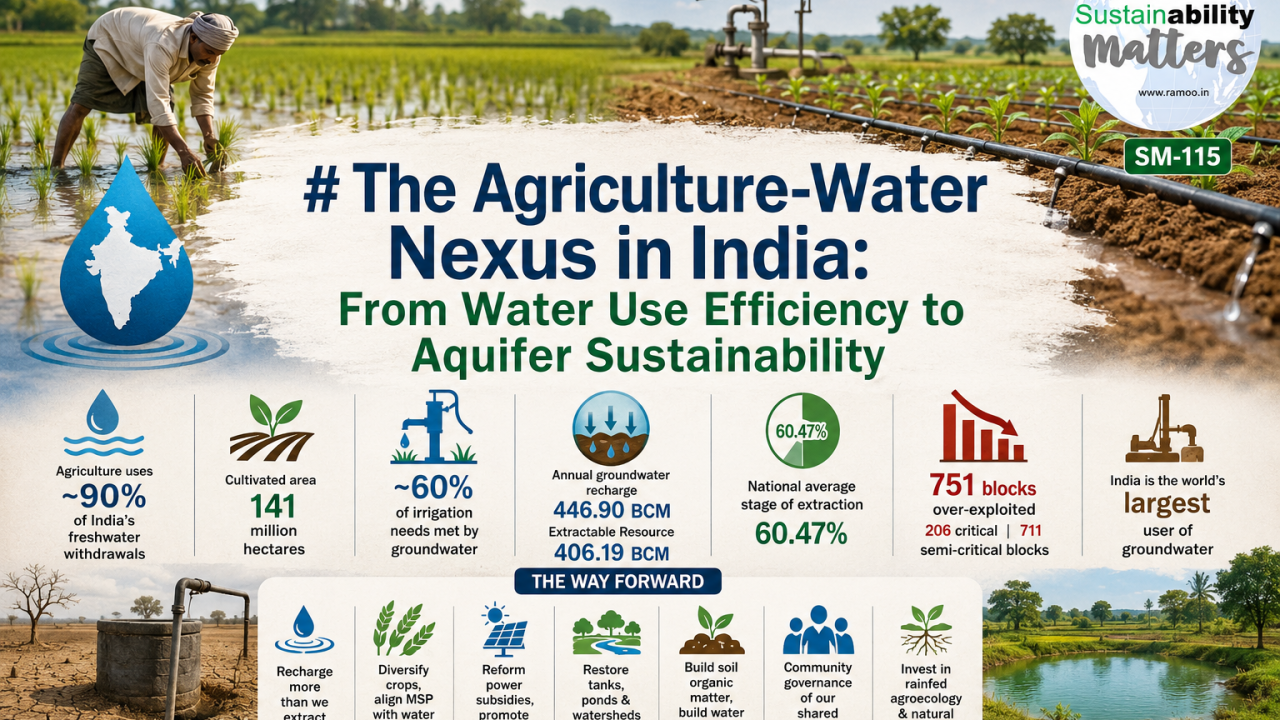
India cultivates approximately 141 million hectares, making it one of the largest agricultural footprints in the world. Agriculture accounts for approximately 90% of total freshwater withdrawals nationally — the highest share among major economies — with groundwater alone meeting the irrigation needs of roughly 60% of cultivated area. The Economic Survey 2024–25 notes that irrigation coverage has risen from 49.3% to 55% of gross cropped area between 2016 and 2021, with further expansion since.
To contextualise this: India receives around 4,000 billion cubic metres of precipitation annually. Of this, approximately 1,869 BCM is assessed as the country’s total water availability (surface water plus replenishable groundwater), according to the Central Water Commission. But availability is not the same as accessibility — a large fraction of rainfall is lost to runoff before it can be captured, and monsoon concentration means that most of the annual precipitation falls within roughly 100 hours across 40 days, making storage the central challenge of Indian water management.
The critical point here is that India does not have a water scarcity problem in the aggregate sense. It has a water distribution problem compounded by a storage and recharge deficit. According to the CGWB’s Dynamic Groundwater Resource Assessment Report 2024 — the most recent national assessment — total annual groundwater recharge stands at 446.90 BCM, with an extractable resource of 406.19 BCM. Annual extraction across all uses is 245.64 BCM, placing the national average stage of extraction at 60.47%. While the headline figure sounds manageable, it conceals extreme regional concentration: in Punjab, 76% of assessed blocks are over-exploited, and in Haryana extraction stands at 135.74% of recharge. The national average is a statistical artefact; the regional crisis is real.
The Groundwater Crisis: What the Numbers Obscure
India is the world’s largest user of groundwater, accounting for roughly 25% of global groundwater withdrawals — more than the United States and China combined. The CGWB’s Dynamic Groundwater Resource Assessment 2024 shows some improvement in national aggregates compared to 2017: the proportion of over-exploited assessment units has declined from 17.24% to 11.13%, and recharge from tanks, ponds, and water conservation structures has nearly doubled to 25.34 BCM. These are genuine gains, partly attributable to the Atal Bhujal Yojana’s community-based management work across 8,774 gram panchayats in seven states, and to Mission Amrit Sarovar’s construction of over 68,000 water bodies. They deserve acknowledgement.
But the improvement in headline numbers should not obscure the severity of regional situations. Out of 6,746 assessed blocks nationwide, 751 remain over-exploited, 206 are critical, and 711 are semi-critical — meaning nearly a quarter of the country’s groundwater-dependent zones are under stress. In Punjab, 114 out of 150 assessed blocks — 76% — are classified as over-exploited, with extraction in some districts exceeding recharge by 164%. The state’s three aquifer layers up to 1,000 feet depth are projected to exhaust by 2039 at current rates, according to CGWB’s own warning published in 2023. In Haryana, groundwater tables fell an average of 5.41 metres between 2014 and 2024; Panipat district recorded extraction at 217.8% of recharge. Delhi crossed the over-exploited threshold in 2024. Punjab and Haryana together lost an estimated 64.6 BCM of groundwater over the seventeen years from 2003 to 2020, according to a joint IIT-Delhi and NASA Hydrological Sciences Laboratory study.
The social consequences compound the ecological ones. As water tables fall, pumping depths increase, energy costs rise, and smaller farmers — who cannot afford to deepen borewells or install submersible pumps — lose access first. In Central Punjab, groundwater levels are dropping by more than one metre every year. The borewell economy has simultaneously enabled an irrigation revolution and deepened agrarian inequality. Well failures are not merely economic setbacks; in rain-shadow regions, they can mean the effective end of a farming household’s livelihood.
The Policy Architecture of Overexploitation
Groundwater depletion in India is not primarily a story of farmer irrationality. It is a story of institutional incentives that make over-extraction the rational choice.
Free and flat-rate electricity is the foundational driver. Across most of peninsular India and large parts of the north, agricultural electricity is provided either free of cost or at heavily subsidised flat rates with no metering. When pumping has zero marginal cost, the rational farmer pumps as long as there is water to extract. There is no price signal, no feedback loop, no individual incentive for restraint. The commons tragedy is not an accident — it is structurally guaranteed by the tariff architecture.
Minimum Support Price distortions compound this. MSP structures have historically favoured rice, wheat, and sugarcane — all water-intensive crops — with predictable procurement, guaranteed price floors, and well-developed marketing infrastructure. Millets, pulses, oilseeds, and other low-water crops have faced far weaker MSP signals and even weaker procurement certainty. The consequence is straightforward: farmers plant water. They plant the crops that return the most value given their input cost structure, and when water is effectively free, the shadow price of water in cropping decisions is zero.
Irrigation-centric performance metrics have reinforced these incentives from the planning side. For decades, agricultural development success was measured in terms of gross irrigated area, water delivery volumes, and yield gains per unit area. Aquifer balance, recharge enhancement, and water productivity were not in the performance lexicon. This is not an incidental oversight; it reflects a deep ideological commitment to the view that more irrigation is always better — a view that made sense when water tables were high but has become catastrophically inadequate now that they are not.
The result is a policy architecture that simultaneously subsidises extraction (through power tariffs), incentivises water-intensive crops (through MSP), and measures success in ways that ignore groundwater depletion. Reform of any one of these without reforming the others will produce only partial results.
The Wrong Crop in the Wrong Place: Regional Water Mismatches
Perhaps no case illustrates the policy-ecology mismatch more vividly than the expansion of paddy cultivation in Telangana.
Paddy is one of the most water-intensive field crops cultivated at scale. It requires 1,200–2,000 mm of water per season, depending on variety and method, and consumes over ten times more water than pulses or oilseeds, which need only 500–600 litres to produce one kilogram of grain. Puddling — the practice of flooding and mechanically churning the topsoil to reduce percolation — is designed specifically to prevent water loss downward into the soil profile. This is ecologically reasonable in the alluvial, high-rainfall environments of coastal Andhra or West Bengal, where aquifer recharge happens through other pathways. In the Telangana plateau, which sits on ancient Archaean basement rock with thin, weathered aquifer layers and a hard-pan subsurface horizon in many areas, it is quite different.
The Telangana plateau receives 800–1,000 mm of annual rainfall concentrated in a short monsoon window. The soils are primarily red and black Deccan types with variable infiltration rates. The underlying geology is predominantly hard rock — granites, gneisses, schists — with limited groundwater storage compared to alluvial systems. Recharge is highly localised, primarily through fractures and weathered zones, and is acutely sensitive to land use.
Against this background, the post-bifurcation expansion of paddy in Telangana — driven by the Rythu Bandhu income support scheme, assured procurement through the civil supplies system, and lift irrigation from new reservoirs — represents a significant increase in water demand in a region with constrained recharge capacity. The state more than doubled its paddy area in a short period, becoming a major contributor to national rice procurement. The aggregate food security logic is real, but the groundwater accounting is not being done at the aquifer level.
Sugarcane in semi-arid Maharashtra and Karnataka presents a similar structural problem. Sugarcane requires approximately 2,000–2,500 mm of water annually — more than double the annual rainfall in large parts of its cultivation zone in Marathwada and northern Karnataka. The shortfall is made up almost entirely from groundwater. In drought years, the same borewells that serve domestic water supply for villages are drawn down to maintain sugarcane fields attached to cooperative sugar mills, creating direct conflicts between food crops and cash crops, between rural water supply and agricultural water demand.
The principle that emerges is simple but resisted: crop choice matters as much as irrigation efficiency. Growing the wrong crop efficiently still depletes aquifers. A drip-irrigated sugarcane field uses less water than a flood-irrigated one — but both use far more than the landscape can sustainably yield. Efficiency and appropriateness are different questions.
The Efficiency Paradox: Why Saving Water Doesn’t Save Aquifers
This brings us to the conceptual heart of the problem.
The standard water-saving narrative — invest in drip and sprinklers, reduce field water use, aquifers recover — rests on an assumption that has been substantially challenged by hydrological evidence globally and is increasingly apparent in India: the rebound effect.
When irrigation efficiency improves, farmers often respond by expanding irrigated area, shifting to higher-value water-intensive crops, or irrigating additional seasons. The net extraction from the aquifer may not fall, and can sometimes rise. A 2024 Mongabay analysis of micro-irrigation impact directly quotes a water governance researcher at ATREE: “Micro irrigation saves water at the farm scale, but the same amount of water savings may not be realised at the aquifer or river basin scale.” This is not a fringe position — it reflects growing consensus in the hydrological literature. The CGWB’s own 2024 report notes that despite improvement in some indicators, the stage of national groundwater extraction has remained essentially unchanged at around 60% since annual measurement began in 2009 — even as micro-irrigation coverage expanded substantially.
The deeper hydrological issue is that traditional flood and furrow irrigation systems, while inefficient at the field level, generate significant return flows — water that percolates below the root zone and recharges the aquifer. Drip systems, by design, apply water precisely to the root zone and minimise percolation. This is their virtue from a water use efficiency standpoint. But it means that the “saved” water does not return to the aquifer — it is consumed by the crop. In hard-rock aquifer zones where recharge pathways are already limited, eliminating these return flows can reduce net recharge even as field-level efficiency metrics improve.
This is not an argument against drip irrigation. It is an argument against assuming that drip irrigation solves the groundwater problem. Water use efficiency is a field-level concept. Aquifer sustainability is a landscape-level concept. The two operate at different scales and respond to different variables.
Recharge depends on infiltration rates (which are determined by soil organic matter, soil structure, biological activity, and tillage practices), percolation pathways (which depend on geology, land use, and watershed condition), surface water connectivity (the degree to which tanks, ponds, streams, and floodplains can slow and sink water before it leaves the watershed), and the integrity of recharge zones (which are often degraded by construction, compaction, or vegetation clearance).
Extraction depends on the aggregate pumping decisions of all users within a shared aquifer, the crop water demands of the dominant cropping pattern, the energy cost structure facing farmers, and the institutional rules — or absence thereof — governing groundwater access.
Drip irrigation addresses neither of these adequately. It does not enhance recharge. It may marginally reduce extraction, but the rebound effect and the area expansion response frequently offset this. The gap between the promise of efficiency interventions and their watershed-level outcomes has been documented in Andhra Pradesh, Maharashtra, and Gujarat — states that have invested heavily in micro-irrigation.
The Half of India That Policy Forgot
Any serious analysis of the agriculture-water nexus must confront an inconvenient fact: approximately 52% of India’s net sown area remains rainfed — dependent entirely on monsoon rainfall with no supplemental irrigation. This is not marginal land. It includes large parts of Vidarbha, Marathwada, Telangana’s uplands, Odisha’s tribal belt, much of Jharkhand, and the dryland farming regions of Karnataka and Andhra Pradesh. These areas account for a disproportionate share of agricultural distress, farmer suicides, and chronic food insecurity.
Rainfed agriculture has received a fraction of the policy attention and investment that irrigated agriculture commands. MSP procurement systems are oriented toward irrigated crops and irrigated belts. Credit systems favour those who can offer land with assured irrigation as collateral. Extension systems were historically designed around the Green Revolution package, which assumed irrigation as a precondition. The institutional infrastructure of Indian agricultural policy — storage, transport, processing, marketing — is concentrated in irrigated zones.
This neglect is ecologically important as well as socially unjust. Strengthening rainfed agriculture through soil moisture conservation, in-situ water harvesting, diversified cropping systems, and agroecological practices represents a different and potentially more durable pathway to water security than expanding irrigation into water-scarce zones. Every hectare that produces adequate yields on rainfall is a hectare not drawing from declining aquifers.
Rainfed agriculture is not a fallback for those who could not access irrigation. In the context of deepening groundwater crisis, it may be the advance party of where all Indian agriculture eventually needs to move — a managed transition rather than a distressed default.
Climate Change: The Accelerant
Superimposed on this structural crisis is a climatic trend that worsens all of the above.
India is already experiencing measurable shifts in monsoon behaviour: increased intensity of individual events, longer dry spells within the monsoon season, earlier withdrawal dates in some regions, and declining certainty in onset dates. Average temperatures are rising, which increases evapotranspiration demands from crops, soils, and water bodies. The net effect is that a given volume of irrigation water yields less crop output than it did two decades ago, because more of it is lost to atmospheric demand.
More significantly, climate change is making groundwater both more important and more vulnerable simultaneously. Surface water availability is becoming less predictable — reservoirs are filling erratically, stream flows are more variable, and tank systems that depended on reliable minor watershed yields are increasingly stressed. Farmers respond by deepening their dependence on groundwater as the buffer against surface water uncertainty. But the aquifers being drawn on more intensively are the same ones that are being recharged less reliably, because the intense rainfall events that now characterise the monsoon generate more runoff and less infiltration.
Climate adaptation in Indian agriculture cannot, therefore, be reduced to drought-tolerant variety development or crop insurance mechanisms alone. It requires a fundamental rethinking of the water storage system — from surface reservoirs and tanks that are vulnerable to evaporation and sedimentation, toward a much greater emphasis on managed aquifer recharge: using good rainfall years to systematically refill groundwater reserves that can be drawn on during drought years.
A New Framework: From Field Efficiency to Aquifer Balance
The shift needed is not merely technical. It requires a different unit of analysis, a different set of performance metrics, and a different institutional architecture.
1. Measure recharge minus extraction, not field water savings. The governing metric of water management must shift from water use efficiency (litres per kilogram of output) to aquifer balance (annual recharge minus annual extraction, by mapped aquifer unit). This requires investment in aquifer mapping, groundwater monitoring infrastructure, and participatory water budgeting at the watershed and gram panchayat level. The Atal Bhujal Yojana — currently operational across 8,774 gram panchayats in 80 districts across seven states — provides the institutional template. Its approach to community water security planning and participatory groundwater monitoring needs to be systematically scaled well beyond its current footprint, with adequate staffing and legal backing.
2. Align MSP with water productivity and ecological suitability. The crop portfolio incentivised by MSP must be brought into alignment with regional water realities. This does not mean eliminating rice MSP — it means differentiating it: higher support prices and procurement certainty for millets, pulses, oilseeds, and other low-water crops; continued but geographically bounded support for rice in genuinely suitable zones; and explicit disincentives for water-intensive crop expansion in over-exploited aquifer areas. The National Food Security Act and state civil supply systems need to be redesigned to include coarse cereals and pulses at scales that create meaningful market demand for diversified cropping.
3. Reform power subsidies without punishing smallholders. Free agricultural electricity has driven the groundwater crisis. But blanket removal of the subsidy in states like Telangana, Andhra Pradesh, or Punjab would devastate small and marginal farmers who have no alternative to groundwater-based irrigation and no resources to absorb higher energy costs. The reform path requires separating the question of who benefits from electricity subsidies from the question of whether metering is introduced and what change the subsidies drive? Restrict to crops with low water use. Solar agricultural feeders — where farmers receive a fixed allocation of solar power and can sell surplus back to the grid — offer one model that simultaneously reduces extraction incentives, lowers fiscal cost, and provides income security. The Kusum scheme provides a framework; it needs implementation at a scale commensurate with the crisis.
4. Restore recharge landscapes, not just deliver irrigation infrastructure. Every rupee spent on new irrigation infrastructure must be matched by investment in recharge restoration. Check dams, percolation tanks, farm ponds, recharge trenches, nala bunding, and wetland rehabilitation are not peripheral “watershed activities” — they are the primary mechanism through which aquifer replenishment occurs. The CGWB 2024 report confirms this: recharge from tanks, ponds, and water conservation structures has nearly doubled since 2017, reaching 25.34 BCM — and this improvement in recharge infrastructure is one of the primary reasons over-exploited blocks have reduced in number. Mission Amrit Sarovar — which has constructed over 68,000 water bodies under Phase 1 — shows what a nationally motivated recharge programme can do. Tank rehabilitation in Telangana and Andhra Pradesh, restoring the historic minor irrigation system that once managed both water supply and recharge across the Deccan plateau, deserves priority investment that currently goes to new lift schemes.
5. Restore soil health as a water intervention. Organic matter is the invisible reservoir in Indian soils. A 1% increase in soil organic carbon in the top 30 cm of soil can increase water-holding capacity by approximately 144,000 litres per hectare. Across 140 million hectares of cultivated land, the aggregate water retention implications of degraded versus healthy soils are enormous. Investment in soil organic matter through composting, green manuring, mulching, cover crops, crop residue management, and reduced tillage is simultaneously an agronomic, climate, and water intervention. It is also one that requires no imported inputs and can be implemented at the farm level without large capital expenditure.
6. Govern groundwater as a common-pool resource. Groundwater in India is legally attached to land ownership — whoever owns the surface has the right to extract the water beneath it. This legal framework is incompatible with sustainable management of shared aquifer systems. While comprehensive legal reform has proven politically intractable, intermediate institutional arrangements — water user associations with monitoring mandates, panchayat-level water budgeting, community-managed recharge programmes — can begin to introduce collective governance logic without waiting for legislative change.
7. Invest in rainfed agroecology. The sustainable agriculture transition that will matter most for India’s long-term water security is one that makes rainfed agriculture productive, dignified, and climate-resilient — not one that brings every rainfed hectare under irrigation. This means investment in soil health, seed diversity, agroforestry, diversified cropping systems, integrated pest management, and market linkages for rainfed crops. Non-Pesticidal Management (NPM) and Community Managed Natural Farming (APCNF) programmes have demonstrated, at meaningful scale in Andhra Pradesh, that productivity can be maintained or improved with drastically reduced chemical inputs and without expanding water demand.
The Region-Specific Imperative
One of the most persistent failures of Indian water policy is the tendency to treat the country’s extraordinary agroecological diversity as a complication rather than as the governing variable. National programmes prescribe uniform technology packages — drip for everyone, zero-tillage everywhere, a single MSP schedule for the subcontinent — without adequately accounting for the fact that what works in the deep alluvial aquifers of western Uttar Pradesh is ecologically inappropriate in the fractured hard-rock terrain of the Deccan.
Telangana’s subsurface hard-pan layers dramatically restrict infiltration in many areas, meaning that even when there is rainfall, groundwater recharge is limited. Paddy puddling in such soils compounds the problem by further destroying soil structure and sealing the profile. Coastal Andhra’s shallow alluvial aquifers with high recharge connectivity are a fundamentally different system. The Indo-Gangetic plains — where groundwater tables in Punjab are falling catastrophically but aquifer storage volumes are still vast — require yet another set of interventions compared to the peninsular hard-rock zones.
Region-specific planning requires aquifer-scale mapping — the CGWB’s National Aquifer Mapping and Management Programme (NAQUIM), now in its second phase as NAQUIM 2.0, is the right instrument but needs to be fully funded and acted upon at the village level. Soil type data must be integrated into cropping pattern recommendations, and administrative jurisdictions should align, where possible, with watershed or aquifer boundaries rather than administrative convenience.
Conclusion: The Aquifer Does Not Read Policy Documents
The groundwater crisis in India is, at its core, a systems failure — a convergence of technological optimism, policy misalignment, institutional gaps, and ecological misunderstanding that has been building for four decades.
Water use efficiency is necessary. It reduces waste at the margin, improves profitability, and buys time. But it is not sufficient. An aquifer is not healed by good irrigation scheduling any more than an overfished sea is healed by more efficient nets. The unit of sustainability is the aquifer and the watershed, not the field.
India’s water future depends on decisions that are currently not being made at scale: crop diversification backed by genuine market infrastructure for diverse crops; groundwater governance with actual enforcement capacity; landscape-scale recharge restoration as a national mission rather than a scheme footnote; power subsidy reform that protects the poor while eliminating the incentive for unlimited extraction; and investment in rainfed agroecology as the adaptive strategy for the parts of India that climate change is making less hospitable to irrigation-dependent production.
The central challenge ahead is not producing more crop per drop. It is restoring balance between recharge and extraction — aquifer by aquifer, watershed by watershed, season by season. The aquifer does not respond to policy intentions. It responds to what we actually put in and take out.
India has the scientific knowledge, the institutional frameworks in embryonic form, and the field experience from diverse programmes to make this transition. What it currently lacks is the policy will to treat groundwater depletion as the civilisational-scale risk that it is, rather than as a technical problem awaiting a better technology fix.
The technology fix is not coming. The framework shift is overdue.
The author works on sustainable agriculture and natural resource policy in India.
Recent Comments