

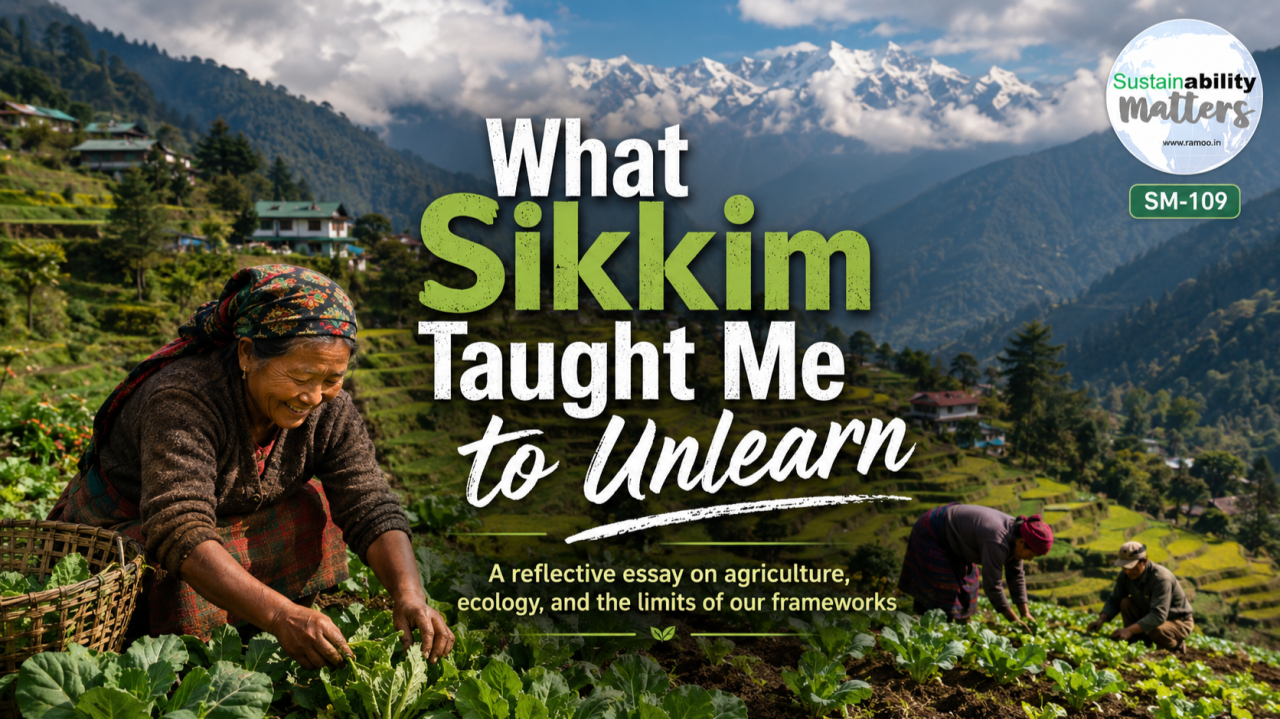
A reflective essay on agriculture, ecology, and the limits of our frameworks
The road into the Yangtey valley in West Sikkim narrows until it stops pretending to be a road at all. On one side, a wall of rock glistens with seepage; on the other, a drop so abrupt it has no bottom you can see. Somewhere below, the hillside resolves into terraces — Upper Yangtey, then Lower Yangtey — small plots stitched into the slope at angles that make a plains farmer’s eyes water. I had come here in 2017 as part of a team from the Centre for Sustainable Agriculture, providing technical support to the North East Rural Livelihoods Project — NERLP — a World Bank-funded programme working with farming communities across Sikkim and Tripura. Our role was specific: support sustainable vegetable cultivation, build Non-Pesticide Management (NPM) practices, and help farmers organise into Producer Groups and eventually Farmer Producer Organisations. We were working across two districts — South Sikkim and West Sikkim — with a target of reaching 2,000 farming households. The programme had clear deliverables, timelines, and metrics.
What it did not have, and what Sikkim proceeded to supply uninvited, was a set of questions for which none of our frameworks had prepared us. By the time the reporting period closed, we had reached 1,512 farmers across 27 villages. We had formed 27 Producer Groups and pushed two cooperatives toward registration. By any programme measure, these were achievements. But the more I looked at what we had actually encountered in those villages, the more I found myself revising not just my understanding of Sikkim’s agriculture, but of agriculture itself.
The Landscape as Argument
There is a habit in agricultural development circles of treating landscape as backdrop — the passive setting within which farming happens. Sikkim dismantled this assumption within the first week in the field.
To travel through Sikkim’s middle hills is to experience altitude as an active force. Temperature drops six degrees for every thousand metres of elevation gain. The monsoon strikes the southern slopes with ferocity; the higher reaches are a different climate entirely. A single block might encompass tropical, temperate, and sub-alpine zones within a two-hour walk. The soils shift from deep loams in the lower terraces to thin, skeletal soils at higher elevations where bedrock barely conceals itself beneath the grass. Landslides are not disasters here; they are geological processes, seasonal events, part of the landscape’s self-revision.
Our work was spread across two very different terrains. In South Sikkim — across the blocks of Ravangla, Temi, Namchi, Sumbuk, and Namthang — the villages sat in the folds of middle hill country: Bering and Jarong off the Ravangla block, Simkharka near Temi, the Jaubari cluster (Upper and Lower Jaubari) below Namchi, the Sadam group (Upper Sadam, Lower Sadam, Rabitar Manghim) out of Sumbuk, and the Perbing settlements further east. In West Sikkim, the geography was even more vertiginous — the Yangtey GPU encompassed six separate hamlets from Upper Yangtey to Lower Bhaluthang; the Yangthang GPU ran through Toyang, Arigoan Chongjong, Upper Yangthang, and down to Lower Kyongsa; the Gyalshing GPU held Lower, Middle, Upper Omchung, and surrounding settlements. Every village had its own microclimate, its own crop window, its own relationship with the hillside above and the valley floor below.
What this meant in practice was that farming here could not be legible through the lens we brought from the plains. The very concept of a “field” barely applied. In many parts of our working area, cultivation happened on terraces so narrow that a single row of beans qualified as a plot. The productivity of such a terrace, measured in kilograms per hectare, was a number that meant almost nothing. Measured against the ecological labour required to hold that soil in place, to maintain the terrace wall, to harvest water from a hillside channel — it became something else entirely.
Rethinking Productivity
The policy discourse around Sikkim’s organic transition tends to focus on yield comparisons, export values, and the premium prices that organic-certified produce commands in distant markets. CSA’s own programme had production targets — we were tracking vegetable output, market surplus, cost of cultivation. These were not irrelevant figures. But they slid past a more fundamental question: productive of what, for whom, and measured over what time horizon?
During the September 2017 field visit by our colleagues from Hyderabad — Dr. Rajshekar and Mr. Chandrasekhar one of the most instructive sessions was a sowing calendar exercise we facilitated with Toyang farmers in West Sikkim. We sat under a corrugated roof in the late afternoon, plotting crop sequences month by month on a large paper sheet. The farmers knew their calendar intimately — they knew which crops could survive the hailstorm season (which, as we would painfully discover the following April, was not a hypothetical risk), which plots dried out first in a dry spell, which slopes stayed wet into November. But when we tried to map this onto a standard cropping pattern grid, the fit was awkward. Their calendar was not a production schedule. It was a reading of the landscape across time, a record of decades of observation about how this specific hillside behaved in each season.
Mainstream agricultural development has been built on the logic of aggregation: increase yield per unit area, reduce labour input per unit output, link smallholder farmers to markets, scale what works. This logic has a coherence, even a moral urgency, in regions where land is flat, soils are deep, water is manageable, and markets are accessible. In the hills around Toyang and Sadam and Jaubari, all four of those conditions were absent or severely constrained. And yet, evaluation frameworks designed for plains agriculture routinely arrived in these mountains and found the farming wanting.
What gets missed is that these communities were not farming in a depleted or sub-optimal version of a plains system. They were farming a mountain ecosystem. The two are not comparable activities that differ only in slope.
In a mountain farming system, the management of the slope itself — the terracing, the maintenance of drainage channels, the strategic positioning of trees to anchor the soil — is agricultural labour, as essential as tilling or sowing. The forest above the cultivated zone is not unused land waiting to be brought under the plough; it is part of the production system, regulating water release, preventing erosion, and providing products that are often more nutritious and more economically significant than the crops below. The fallow is not idleness; it is the system repairing itself.
The Forest is the Farm
Perhaps the single most important thing our field experience in Sikkim forced us to confront was the centrality of non-timber forest products to household economies that official statistics classify as farming households.
Large cardamom (Amomum subulatum) is Sikkim’s most famous agroforestry product, and it illustrated the point well. It grows in the shaded, humid gullies of the middle hills, under a canopy of alder trees that fix nitrogen and moderate temperature. It demands dense forest cover, clean water, and stability of slope. You cannot grow it by clearing the forest; you grow it within the forest. The alder-cardamom system is an arrangement developed over centuries whose productivity depends entirely on the health of the ecological system in which it is embedded. We included cardamom in our Package of Practices materials — the Nepali-language PoPs we developed for Sikkim also covered ginger, cabbage, cauliflower, tomato, and brinjal — but the more time we spent in the cardamom gardens, the more we understood that no Package of Practices could substitute for the accumulated knowledge of how to manage the garden’s relationship with the forest above it.
Beyond cardamom lies a vast, seasonally varied harvest of mushrooms, fiddlehead ferns, wild berries, medicinal roots, bamboo shoots, and minor forest materials that move through household economies with almost no formal market trace. Across the Bhaluthang villages and the Onglop cluster in West Sikkim, a family might spend a fortnight after the monsoon gathering forest products from slopes they had known for generations, consuming some, selling some in local markets, exchanging some within community networks. None of this appeared in any agricultural survey. It did not figure in any productivity database. Yet for those households, it might represent a month of nutrition and a significant fraction of discretionary income.
The policy implication of this was uncomfortable. It meant that any intervention aimed at increasing agricultural productivity in Sikkim’s hill communities — by clearing “underutilised” forest, consolidating small plots, introducing high-yielding varieties, intensifying input use — was almost certainly destroying the very livelihood base it claimed to strengthen. The forest was not separate from the farm. In these landscapes, the forest was the farm.
What the Farmers Know
I want to be careful here about romanticisation. The knowledge systems I encountered were sophisticated, but they were not uniformly present, not always internally consistent, and not immune to the erosion that comes with economic change and generational discontinuity. They were knowledge systems under pressure, like most things in the contemporary highlands.
That said, the depth of situational understanding I witnessed in experienced farmers was, by any honest reckoning, extraordinary.
In the Sadam cluster — a group of villages we visited during our September 2017 field tour, including a long discussion at a South Sikkim SHG federation gathering — a farmer walked us through his reading of a particular slope where he had grown ginger for twenty years. He described the drainage pattern by pointing at a fold in the hillside that, to my eye, looked identical to the surrounding terrain. He could identify three distinct soil types within a hundred-metre radius by feel alone. He knew exactly how the cloud shadow moved across that ridge in June, and how this affected moisture retention in the weeks before transplanting. His planting decisions, his fallowing schedules, his choices of inter-cropped species, tracked these assessments with a precision that a soil laboratory would have difficulty improving upon, and with a speed and economy that a laboratory cannot match at all.
His knowledge was not abstract; it was situational, embodied, and accumulated over a lifetime of observation in one specific landscape. It was not transferable as a package. It was what the extension literature calls “tacit knowledge” — which is another way of saying that it cannot be extracted from its context without being destroyed.
What troubled me, during those weeks in the field, was how little formal agricultural extension was structured to value this. Our programme, like most development programmes, was structured around the transfer of information to farmers — NPM practices, new crop varieties, FFS methodology, FPO concepts. The transfer of knowledge from farmers to the systems we were ostensibly trying to strengthen was not, in any meaningful sense, built into the programme architecture. We were listening, in individual conversations. We were not learning, structurally.
Dr. Tshering Bhutia, the training coordinator at KVK West Sikkim, whom we met during that September visit, put it plainly: the extension system was still, fundamentally, oriented toward delivering messages downward. The feedback loop was weak. The institutional memory of what farmers already knew was thin.
A Season of Hailstorms
Nothing calibrated us to the realities of mountain farming quite like what happened in April and May 2018.
We had seeded nineteen organic seed production plots across West Sikkim — farmers in Toyang, Arigoan Chongjong, Upper Yangthang, Bhaluthang, Onglop, and Gyalshing had taken up tomato, bittergourd, and bottlegourd varieties sourced from the Indian Institute of Vegetable Research in Varanasi, following three days of training at Gyalshing in January. The farmers had sown carefully, recorded their nursery dates, maintained their plots through the cold months. Then came the hailstorms — cyclonic rain events and heavy showers that swept through the region repeatedly through April and into May. Every open plot was damaged. The season’s seed production effort was effectively lost.
For the programme, this was a setback to be documented, reported, and responded to with revised planning — perhaps protective cultivation under polyhouses in the next season, as we noted in our report. For the farmers, it was something they had lived before and would live again. The hailstorm was not an anomaly in their calendar; it was a risk they priced into every planting decision, a reason why diversification across crops, plots, and income sources was not a policy recommendation but a survival logic. The loss hurt. But because no household had concentrated everything into a single open seed plot, no household was destroyed by it.
This, I have come to believe, is the most important lesson Himalayan farming has to teach: that resilience in fragile mountain systems comes from diversity and redundancy, not from optimisation. Every pressure from the development system — consolidate, specialise, scale, market-integrate — runs directly against the ecological rationality of dispersion. The farmers in Toyang and Jaubari and Sadam were not being irrational when they maintained ten small plots of different crops at different elevations. They were being precisely rational, in the face of a climate that punishes concentration severely and often.
The Generation at the Crossroads
The younger generation in Sikkim’s hill villages did not always want what their parents had. This was not a failure or a tragedy; it was a human reality, and it deserves to be stated plainly.
The children of the ginger farmer and the cardamom grower had, in many cases, completed schooling, acquired smartphones, and developed aspirations that extended well beyond the village boundary. They wanted salaried positions — in Gangtok, in Siliguri, in the armed forces, in government. They were not wrong to want this. The labour conditions of hill farming — the physical difficulty, the weather exposure, the price volatility, the isolation — are genuinely harsh, and no amount of philosophical elevation of traditional knowledge changes that material reality.
The tension this creates is not easily resolved. If the knowledge systems that sustain these landscapes are not transmitted — if they leave with the generation that holds them — then Sikkim’s organic certification, which it wears proudly and has earned with real institutional effort, becomes, in a generation’s time, a certification without a knowledge base. You can prohibit chemical inputs. You cannot, by mandate, preserve the understanding of how to manage a Himalayan hillside without them.
Our 27 Producer Groups, and the cooperatives we were helping register in both districts, were partly an attempt to create institutions that could anchor this continuity — structures through which younger people might find roles in aggregation, logistics, and market linkage that made staying in the village a viable economic proposition rather than a default. Whether that institutional bet holds is a question that outlasts any project reporting period.
Economics at Altitude
The economic arguments for Sikkim’s organic transition are real but narrow. The weekly vegetable surplus we documented across the clusters was substantial — the Jaubari cluster in South Sikkim alone was producing 9,500 to 10,000 kilograms a week of cabbage, cauliflower, beans, chilli, radish, peas, and potato. The three Yangtey, Gyalshing, and Yangthang clusters in West Sikkim were each putting out similar volumes. These were not trivial quantities.
But getting this produce to Gangtok — the primary market, identified after our colleague Bala Subrahmanyam conducted a detailed survey across Jorethang, Namchi, Singtam, Ravangla, and Gangtok itself — meant a four-hour drive of 70 to 80 kilometres over roads that closed unpredictably in the monsoon. The 30 to 40 percent escalation in retail price between farmgate and Gangtok’s Lall Bazar did not all flow back to the farmer; a significant portion disappeared into the logistics cost, the trader’s margin, and the spoilage that mountain roads inflict on fresh produce. Pelling, the tourist hub in West Sikkim, offered a premium seasonal market — but only for four months of the year.
These constraints are structural. They are not solved by organic certification, better training, or improved varieties. They are the geography, and the geography does not change. What our market study revealed, in its careful way, was not just a supply chain problem but a fundamental question about what kind of economy is actually possible in terrain like this. A business plan calibrated to the economics of a plains vegetable cooperative would, in this context, consistently underperform. Not because of management failures, but because the premises were wrong.
What does create genuine economic opportunity is the convergence of organic farming with landscape-based livelihoods — eco-tourism, nature interpretation, cultural heritage. The organic branding Sikkim has built, painstakingly, at the state level provides a platform. But this too has ecological limits. The carrying capacity of Himalayan tourism is finite, and growth beyond that constraint defeats the purpose.
A Place That Teaches Modesty
Sikkim has been framed, in much of the policy literature and popular coverage that followed its organic declaration in 2016, as a model — a template for other states and other countries to replicate. I am sceptical of this framing, not because Sikkim’s achievement is unreal, but because the framing obscures what is actually interesting about the place.
Sikkim is not a model. It is an argument — an ongoing, unresolved, ecologically embedded argument about what agriculture is for, what productivity means, and what kind of knowledge actually sustains landscapes over the long run. The lesson it offers is not a set of policy prescriptions; it is a set of corrections to our assumptions.
It corrects the assumption that farming can be understood in isolation from the forest and water systems around it. It corrects the assumption that productivity is a straightforward function of yield per hectare. It corrects the assumption that knowledge can be extracted from its context, packaged, and delivered. It corrects the assumption that development is a process with a defined destination.
These corrections matter well beyond Sikkim’s borders. The Himalayas are the water towers of South Asia. The glaciers and high-altitude wetlands that regulate stream flow across the subcontinent are downstream consequences of land management decisions made in places like Toyang and Sadam and Bhaluthang. The biodiversity concentrated in this biogeographic hotspot — Sikkim has more plant species per square kilometre than almost anywhere else in South Asia — represents an ecological library that we are only beginning to read. The climate regulation provided by intact Himalayan forests is not a local good; it is a continental one.
When we talk about Sikkim’s organic transition as a branding story, we are not wrong, but we are looking at the smallest part of the picture. The larger picture is that a population of farming communities, over generations, has managed a fragile and extraordinarily complex mountain ecosystem in a way that has kept it ecologically functional, biologically rich, and hydrologically stable. That management is the achievement. The organic certification is a contemporary annotation to a much older text.
Unlearning as Method
I came back from those years in Sikkim a less confident agricultural professional. I had arrived with frameworks — livelihoods assessments, value chain maps, productivity benchmarks, FPO formation templates — and I returned having found their edges, the places where they gave out. For a while, I was not sure what to do with that.
What I eventually understood is that the discomfort was the lesson. The landscape had not failed to fit my frameworks; my frameworks had failed to fit the landscape. That is a meaningful distinction. A framework that fits all landscapes is not an analytical tool; it is an ideology.
What Sikkim offered, if I was willing to receive it, was not a model to replicate but a calibration to apply — a reminder that the categories we use to think about agriculture are not natural categories but historical ones, derived from a particular trajectory of intensification, mechanisation, and market integration that has no necessary claim to universality.
To manage a hillside sustainably across generations, you need to understand the hillside — its soils, its water, its microclimates, its biological communities, the particular way it behaves in a hailstorm year versus a dry year. You need to understand it in a way that is embedded in practice, inherited in knowledge, and expressed in daily decisions made by people who live there. You cannot download that understanding from a database or deliver it through a three-day training. You can only support the conditions under which it persists and evolves.
The twenty-seven Producer Groups we helped form across those hill villages are, if they endure, institutions for continuity as much as for commerce. The Nepali-language crop guides we produced for cardamom and ginger and the brassicas are useful — but their real value would be if they prompted conversations between older farmers and younger ones, if they created occasions for the tacit to become explicit before it was lost. Whether they serve that function depends on choices made in village meetings we are no longer part of.
That is the honest position of any outside technical agency working in landscapes like these: we pass through, we contribute what we can, and then the landscape and its communities do what they have always done — carry on, adapt, absorb, and occasionally surprise us. Sikkim, in my experience, does a great deal of surprising. The appropriate response, I have come to believe, is to arrive ready to be taught.
Recent Comments