

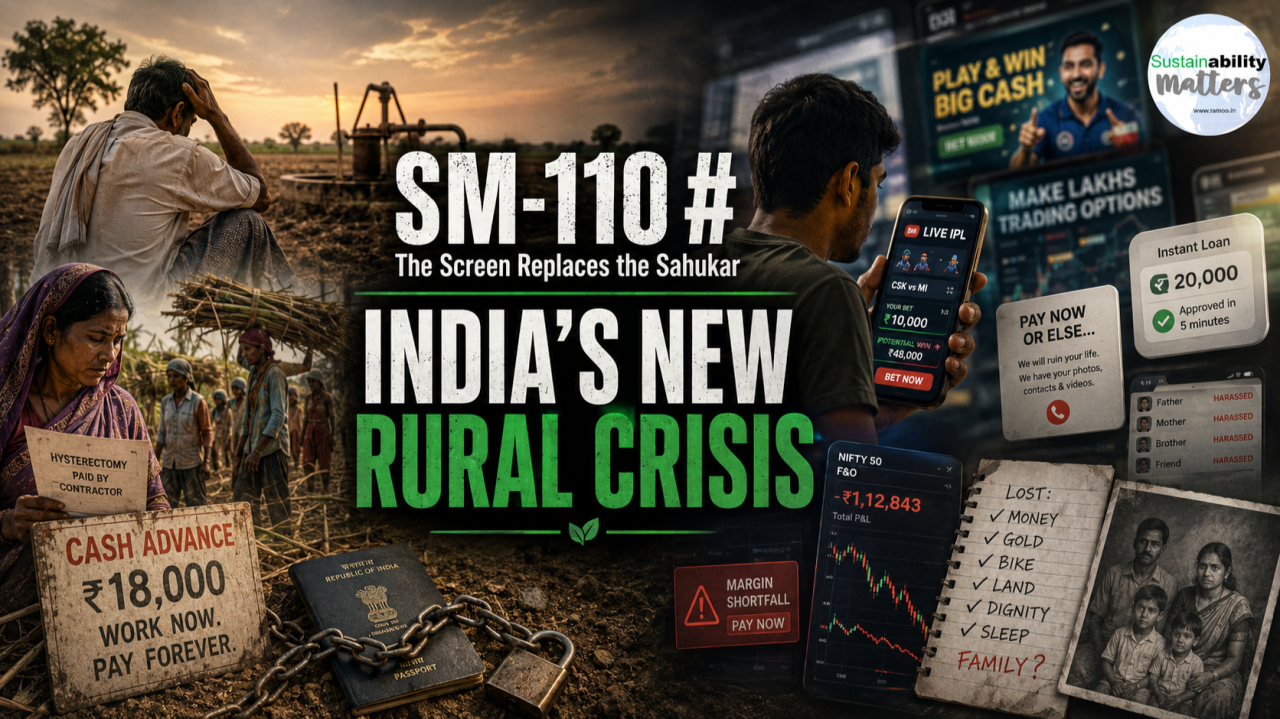
In October 2024, a small farmer from Solapur district in Maharashtra flew to a Southeast Asian capital. He was not going on holiday. He was going to sell a kidney for roughly eight lakh rupees to pay off loans he could no longer service. The surgery took place at a hospital there. He came back to his village. The money paid some lenders. The same network of agents then arranged a job for him in another Southeast Asian country, where his passport was confiscated and he was assaulted. By the time he reached an FIR in December 2025, investigators had begun unspooling a transnational network of agents, hospitals, and doctors stretching from Maharashtra to Tamil Nadu to Phnom Penh. The agent who recruited him had himself previously sold his own kidney.
Two hundred kilometres east, in Beed district, sugarcane harvesters are still being recruited by jodi — couple labour — under cash advance contracts. Studies have shown that of around 82,200 women cane workers in Beed, roughly one in five had a hysterectomy, often paid for by the same contractor who paid the advance. The uterus, like the kidney, becomes collateral on a wage that was never enough.
A thousand kilometres south, in a Telangana mandal, a young man was found hanging from a tree on his family’s field in June 2025. He had been addicted to an online betting app. The same month, in a small village in Andhra Pradesh’s Chittoor region, a middle-aged man addicted to online rummy and betting mortgaged the family land, pledged his wife’s jewellery, diverted chit fund money, and eventually killed his wife and mother before his own children were run over by a train during the chaos that followed his suicide attempt. In another district nearby, a young man’s IPL betting losses led his father to sell the family house; the son continued betting; the entire family of four eventually took their own lives.
These are not three different stories. They are three faces of the same structure.
The popular framing — that India’s rural crisis is the same old agrarian distress dressed in new clothes — is wrong in a specific and dangerous way. The old crisis killed farmers through borewell debt, BT cotton input traps, and crop price collapse. It came through visible mechanisms: the sahukar in the village, the trader in the mandi, the dealer at the fertiliser shop. People knew who was extracting from them. The shame was real but it was social — known, named, locally bounded.
The new crisis kills through a screen. It enters the household through a five-inch glass surface and a recharge that costs less than a bus ticket. It extracts not through the visible sahukar but through an offshore betting company, a foreign-funded digital lending app, a fantasy gaming platform headquartered in Mumbai but advertised by an actor the village admires, a financial exchange that the family did not know its son was trading on. The architecture is invisible. The losses are private. The shame is hidden. And the rate of extraction is, by any historical comparison, breathtakingly fast.
This essay is an attempt to map that architecture — not to moralise about youth, not to indulge the easy nostalgia of village virtue lost, but to do what political economy is supposed to do: ask who profits, who pays, who built the rails, and what the state and the village can do about it. The crisis unfolding across Maharashtra, Telangana, Andhra Pradesh, Punjab, and increasingly Bihar, Madhya Pradesh, and Odisha is a crisis of digital capitalism colliding with structural rural underemployment. The smartphone did not cause it. The smartphone became its delivery mechanism.
I. The Continuity, and the Rupture
To understand why this crisis is different, we have to be honest about what stayed the same.
The classical agrarian crisis — the one Vidarbha became shorthand for — had a recognisable shape. Farmers borrowed for inputs. Weather, pest, or market betrayed the harvest. The price collapsed, the loan compounded, and at some point a borewell drilled into dry rock or a daughter’s marriage came due and the loan became unrepayable. The pesticide was usually within reach. The government’s response was almost always a waiver — a Band-Aid that left the underlying machinery intact.
The mechanism was structural. Indian agriculture had been pushed into a high-input, high-cost, low-margin trap by Green Revolution path dependencies. The state had withdrawn from extension, credit, and procurement. Private trade and agribusiness moved in on terms that extracted surplus rather than secured income. Caste hierarchies decided who got loans on what terms. Climate variability did the rest.
That crisis has not gone away. NCRB data continues to record farmer and farm labourer suicides in tens of thousands annually. Crop price volatility remains acute. MSP coverage remains narrow. The “Urea Republic” — the deeply distorted fertiliser ecosystem that traps Indian soils in input dependence — is still in place. The underlying conditions of rural insecurity have only deepened.
What is new is that those conditions have collided with three other developments, all roughly simultaneous, all national.
One, the demographic bulge of rural youth without dignified work. India’s rural workforce has become younger, more educated, and more underemployed than at any point in its history. A boy who finishes Class 12 in a village in north Telangana or eastern Maharashtra is better educated than his father and significantly less likely to find work that uses that education. Too educated for cane cutting, not educated enough for the call centre. Structurally idle, restless, on his phone, and ashamed of being idle.
Two, the universal smartphone. The 2016 launch of low-cost 4G made India one of the cheapest data markets on earth. A village teenager today has frictionless access to global financial markets, global advertising, and global gambling at a price his family can afford. There is no historical parallel.
Three, the financialisation of everyday life. UPI, instant credit scoring, KYC-on-Aadhaar, and app-based loan disbursement have collapsed the time between desire and transaction to seconds. A bet is placed in the time it takes to think about it. A loan is disbursed in five minutes. A trading position opens on a phone in a tractor cab. The friction that used to give people time to reconsider — the trip to the bank, the conversation with the manager, the witness of neighbours — has been engineered out.
Place rural underemployment, universal smartphones, and frictionless finance in the same household, and you do not have the old crisis with new tools. The old extraction was seasonal; the new one is continuous. The old crisis was visible; the new one is atomised and secret. The old crisis was collective — whole villages affected by the same drought — while the new one is private, each young man trapped alone in his phone, his losses, his shame, his dopamine.
Calling it the “new rural crisis” is not a literary flourish. It is a structural claim.
II. Adaptation Without Protection
There is an important corrective worth making before going further. The young man trading options on his phone, the farmer flying to Phnom Penh, the daughter pledging her gold to clear her brother’s loan-app debt — none of these are simply passive victims of a predatory architecture. They are people trying to adapt to a crisis they did not create.
Rural households have always adapted. When the cotton crop failed for the third year in a row, you sent a son to the city. When the city stopped absorbing, you tried a dairy animal. When the cooperative closed, you found a private collector. Adaptation under agrarian stress is not weakness; it is the intelligence of survival. The old crisis was brutal, but its victims knew the terrain. The moneylender’s face was familiar. The interest rate, however usurious, was calculable. The crop failure, however catastrophic, was legible. You could negotiate, defer, borrow from a relative, approach the panchayat.
What is different now is not that farmers are adapting. It is that the agents of exploitation are also innovating — and innovating faster, with more capital, more data, and more technological sophistication than any previous generation of rural extractors.
Consider what the new agents have built. The old sahukar charged 36 percent annual interest and relied on social coercion — the threat of shame, the weight of village hierarchy. The new digital lender charges 365 percent annual interest, uses machine learning to identify the most credit-desperate users, disburses in five minutes before second thoughts can form, and weaponises the borrower’s own contact list for recovery. The old moneylender knew his borrower personally and had some social limit on how hard he could push. The new lender is algorithmically optimised to push past that limit. This is not the same product with a digital interface. It is a qualitatively more extractive instrument.
The betting platform is similarly not just a digital version of the old village card game. It is a product built by behavioural scientists to maximise the duration of engagement and the rate of loss-chasing. Variable reward schedules, near-miss engineering, personalised odds adjustment, social proof through visible “winners” — every element is designed using the same psychological literature that casinos have refined over decades, now deployed at population scale through a phone in every pocket. The rural gambler at the old teashop card game faced a fixed opponent with human limits. The rural youth at the fantasy sports or online betting app faces a system that knows his loss history, his emotional triggers, and his chasing patterns better than he knows them himself.
The organ trafficking network represents the most disturbing form of this innovation. What was once a crude, locally organised criminal activity — a broker, a corrupt doctor, a vulnerable debtor — has been vertically integrated into a transnational supply chain. The debt is generated locally, through a combination of crop failure, digital lending, and gambling loss. The broker is typically a local man, himself a previous seller, who has been recruited into the network and given a commission for each new supplier. The surgery happens abroad, in jurisdictions where enforcement is weaker, returning the seller to India with a scar and a partial payment. The network has developed standard operating procedures — standard payment ranges, standard routes, standard medical facilities, standard post-operative management. It has, in other words, achieved the efficiencies of a supply chain. What was sporadic exploitation has become systematised.
The sugarcane contractor in Beed who finances a hysterectomy to secure uninterrupted labour supply from a woman worker has made the same calculation. He has innovated on the debt-bondage model. The advance is no longer just a loan; it is a mechanism to access and modify the worker’s body to serve the production schedule. This is extraction that has moved inside the human organism.
In each case, the pattern is the same: a household under structural distress reaches for what looks like an adaptation, and finds that the adaptation was designed — by people with much more information, capital, and institutional support — to extract rather than relieve. The household is adapting. The exploiters are innovating. And the distance between the sophistication of the two sides is growing, not shrinking.
Three institutional failures allow this distance to grow unchecked.
Regulatory failure. The products being offered to rural households as adaptation strategies are either unregulated or actively designed to evade regulation. The digital lender charges interest rates that would be illegal in any supervised microfinance institution. The offshore betting platform operates outside Indian jurisdiction. The retail derivatives account is technically regulated but with disclosure standards no first-time trader from a small town actually reads or understands. The kidney broker operates illegally, but exploits the gaps between state health, police, and immigration systems that do not talk to each other. In every case, the household assumes that the existence of a product in the marketplace implies some basic protection. That assumption is false, and the state has not made the effort to communicate that it is false.
Educational failure. There is no rural extension system in India today that teaches young men what options expiry actually means, or how an annualised effective interest rate of 365 percent computes into a weekly payment, or how a fantasy gaming algorithm is designed to manufacture near-misses. The agricultural extension system, weakened as it is, at least exists in institutional form. The financial extension equivalent — a system that would explain digital finance to rural households the way KVKs once explained crop science — does not exist at all. School curricula say nothing about gambling psychology or algorithmic manipulation. The void is filled by influencers who are paid by the platforms themselves, teaching the product’s mythology rather than its mathematics.
The silence of the household. This may be the most consequential failure, and it is what most directly distinguishes the new crisis from the old. When a farmer in the older crisis took a loan from a sahukar, the village knew. When his crop failed, the village knew. Visibility was painful, but it was also the precondition of help — relatives stepped in, the panchayat occasionally intervened, the cooperative bank rescheduled. There was a social network for visible distress.
The new crisis is hidden by shame. A young man does not tell his father that he lost two lakhs on options last week. A father does not tell his brother that the family land has been pledged. A wife does not tell her own parents that her husband is being harassed by recovery agents. A son who has flown to Phnom Penh to sell a kidney tells the village he went for a job. The household closes around the secret. By the time the crisis becomes visible — usually when somebody dies — the financial damage is irreversible and the social possibility of collective response is gone.
The shame is a specific cultural product of the new crisis. Pesticide suicide in the old crisis carried grief but rarely stigma; everyone understood the harvest had failed. Betting suicide in the new crisis carries deep stigma, because the loss is read as personal moral failure — the boy “wasted” the money, “didn’t have control”. The village’s older sympathies do not transfer. Even state compensation schemes often exclude betting- and loan-app-induced suicides because they are not classified as “agrarian distress”. Farm families, watching this, learn to keep the new debts invisible until it is too late.
The household is not failing morally. It is adapting intelligently to structural distress, through the only options a failing economy puts in front of it. The problem is that those options have been engineered — by people with far greater sophistication and information — to extract rather than support. The race between farmer adaptation and exploiter innovation is not a fair one. And the state, the school, and the village community, which could level it, are largely absent from the field.
III. The Architecture of Extraction
A good rule for analysing any new system of harm in India is to ask: who built it, who funded it, who lobbied for it, who advertises it, who collects from it, and who carries the loss. Once those are clear, moral panic becomes unnecessary. The system is doing what it was built to do.
The betting and gaming economy
Before the Promotion and Regulation of Online Gaming Act of 2025, India’s online real-money gaming sector was a roughly twenty-three-billion-dollar industry generating around Rs 31,000 crore in revenue and Rs 20,000 crore in tax contributions. The single largest fantasy sports platform alone had over 280 million users and reported revenue of around Rs 9,600 crore in FY24, with more than 90 percent coming from real-money contests. Other major fantasy, rummy, and poker platforms ran on the same model: small deposits from millions of users, mostly young men, structured around cricket and other high-engagement events.
The legal architecture was the “game of skill” defence. By insisting that fantasy sports were skill-based rather than chance-based, the industry occupied a constitutional perch under Article 19(1)(g) that High Courts had reaffirmed. Underneath, a much larger illegal offshore industry operated freely. A 2025 report estimated that the top fifteen illegal betting platforms logged over 5.4 billion visits in FY25, with annual deposits estimated around a hundred billion dollars. In March 2025, the largest offshore platform alone had more traffic in India than the country’s biggest e-commerce sites, search engines, and social media platforms combined. The Enforcement Directorate eventually froze around Rs 110 crore in mule accounts and seized about 1,200 credit cards linked to one such platform, alleging it generated over Rs 3,000 crore in a single year through surrogate Indian entities.
The August 2025 ban swept all of this — fantasy, casino, rummy, poker, sports betting — into one prohibited category. Over 7,800 betting sites had been blocked by January 2026. But banned platforms reappear under mirror domains within days. The Act criminalised the supply side without addressing the demand side, which is the actual problem — what an unemployed twenty-three-year-old in a small town does with his hours.
The loan app economy
If betting and fantasy gaming created the appetite for quick money, instant digital lending created the rails to finance the bet. This is the key structural insight that most reporting misses: the two ecosystems are not separate. They feed each other.
Instant digital lending apps typically disburse loans of Rs 10,000 to Rs 25,000 with monthly interest of 20-30 percent and processing fees of up to 15 percent. The annualised effective interest rate often crosses 200 percent, and in some unregulated apps reaches 365 percent per annum. Recovery practices have shocked even Indian regulators, who have seen plenty.
In Bhopal in August 2023, an insurance firm worker, his wife, and their two small children took their lives by suicide after months of harassment by loan recovery agents. The final message threatened to circulate morphed nude images of the borrower on social media. This is not exceptional. This is the recovery model. Apps gain access to borrowers’ contacts and photographs at the time of disbursement; recovery agents then begin contacting relatives, colleagues, and neighbours, sometimes within four to six days of the loan being approved.
A 2024 BBC documentary identified around sixty suicides linked to digital loan app harassment. The actual number is almost certainly much higher; many cases never become news, especially in rural areas. The Telangana Cyber Security Bureau has described instant loan app fraud as one of the state’s fastest-growing cybercrime threats. In Kerala in early 2025, a first-year dental student died in circumstances that led police to register a case against the loan app concerned.
The pattern repeats: small loan, missed payment, second loan to repay first, third loan to repay second, harassment of family contacts, social humiliation, suicide. The mechanism is precise and replicable. The platforms are interchangeable; the harm is structural.
The retail derivatives economy
This is the part of the architecture that the regional language media still under-reports, because it does not yet have the visual drama of village suicides. But it may be the largest single channel of wealth destruction now operating in India.
The numbers, from SEBI itself, are remarkable. Between FY22 and FY24, 1.13 crore unique individual traders incurred a combined net loss of Rs 1.81 lakh crore in equity futures and options. In FY24 alone, 90 percent of retail F&O traders lost money, with losses totalling Rs 1.05 lakh crore across 96 lakh accounts. FY25 was worse: net losses of Rs 1,05,603 crore, with 91 percent of participants in the red, and cumulative losses between FY22 and FY25 reaching Rs 2.88 lakh crore.
Two facts about this loss profile matter. First, the most active F&O traders are under thirty years of age and earn less than Rs 5 lakh annually. Second, a disproportionate share come from smaller towns — places where discount brokerage advertising on YouTube reaches the same boy who is also seeing fantasy gaming ads and surrogate betting ads.
A leading discount brokerage’s own founder, citing SEBI data, noted that sixteen percent of active retail traders lost their entire capital in FY25. One in six wiped out. The institutional and proprietary side of the market, meanwhile, was profiting — in FY24, proprietary traders booked gross profits of Rs 33,000 crore and foreign portfolio investors Rs 28,000 crore, with 96-97 percent of those profits attributed to algorithmic trading. This is a transfer mechanism, plain and clean: from millions of small accounts run by young men with smartphones to a few hundred algorithmic accounts run by professionals with co-located servers.
The “retail investor” of Indian financial influencer mythology is a heroic figure who, by mastering charts and discipline, takes wealth from the institutions. The data describes the inverse. The institutional algos are taking wealth from the retail rookies, and the influencers — who claim to teach the rookies — are being paid by the brokers, who profit from the transactions either way.
SEBI has responded with measures: contract sizes have been raised, weekly expiries restricted, upfront premium collection enforced. But retail F&O participation has recovered after a brief dip, with average daily premium turnover in Q3 FY26 actually surpassing pre-curb levels. The boys are still trading, and they are still losing.
The combination
These three economies — betting and gaming, instant lending, retail derivatives — are not separate. They are layered. A young man bets on the IPL with Rs 10,000 borrowed from a loan app. He loses. He takes another loan and bets on a higher-odds market. He loses again. He opens a brokerage account on the advice of an Instagram influencer who promises he can “make back” his losses through options. He loses again. He takes a personal loan from his bank. He sells his wife’s gold, his motorcycle, and pledges the land in his father’s name — without the father knowing. By the time anyone in his family realises what is happening, the loss is in lakhs and the harassment calls have started. This is the typical case. It is being lived in tens of thousands of households right now.
IV. Manufactured Dreams: Aspirational Capitalism in the Village
Behind the architecture sits a cultural apparatus designed to feed it. To understand why the architecture works, we have to look at what people are watching, who they are watching, and what they are being taught to want.
A generation ago, the dignity of labour — the idea that work itself was honourable, that producing something with one’s hands was a basis for self-respect — had cultural support across most of rural India. It was reinforced by family, school, panchayat, temple, mosque. It carried caste baggage, but the social texture supported it.
That texture is gone. In its place is a media environment that systematically devalues productive work in favour of visible wealth. The Telugu film hero owns multiple cars, throws money in air. The cricket star promotes a fantasy app. The “finance YouTuber” claims he made fifty lakhs trading options last year and you can too. The Instagram reel shows a twenty-five-year-old in Dubai with a Lamborghini and a “trader” caption. The Telegram group claims its tips are 80 percent accurate. The successful man, in this iconography, is not the man who farmed well or built a small enterprise that employs ten people. The successful man is the one who got rich fast, off something the viewer does not quite understand but can imitate with one tap.
This is not accidental. It is a coordinated production system. Behind almost every viral “finance influencer” sits either an unregulated tipping service, a brokerage paying for client acquisition, a real-money gaming platform, or — increasingly — an offshore betting operator using surrogate advertising. Indian regulators have caught up to part of this; in Telangana, cases were filed against around twenty-five actors and influencers, including major Telugu film personalities, for promoting online betting apps. But by the time cases are filed, the cultural damage is done.
The psychological consequence is what I have started calling the collapse of patience. Rural youth a generation ago understood that wealth accumulated slowly: a plot here, a small dairy operation there, a brother sent abroad. Two decades and you had something. The new aspiration is that wealth should arrive next Tuesday. By the IPL final. By the end of the month. By the expiry of this option contract.
When wealth does not arrive, the response is not to recalibrate the expectation; it is to double the bet. This is not a flaw in the youth. It is a designed feature of the platforms — every gambling research literature, every behavioural economics paper knows that the surest way to keep a user is to give him a near-miss and a way to chase the loss. The platform’s profitability depends on this. The young man is doing what the algorithm was built to make him do.
Masculinity feeds the loop. In village social settings, the young man with money in his pocket is respected. The young man trading on his phone in a roadside chai shop can perform that respect even before the money arrives; he can show the screen, talk in English-laced trading jargon, announce his “calls”. The peer group rewards the performance, which delays the moment of confronting losses. Group chats among young men function as continuous validation engines for risk-taking behaviour. By the time someone in the chat actually loses badly enough to die, the others find out at the funeral.
What has collapsed is not just the dignity of labour. It is the entire ecology of waiting. Patience, slow accumulation, intergenerational savings, the building of small things over time — these were not just economic strategies; they were the basis of village social trust. They are being replaced by an aesthetic of instant visibility, in which the proof of success is not what you built but what you can display in a story on a phone.
V. From Speculative Loss to Land Loss
The most consequential effect of the new architecture is that it is accelerating asset transfer out of farming households at a scale the older crisis never managed. This is where the new crisis ceases to be a “youth problem” and becomes an agrarian one.
In the older crisis, the typical pathway from distress to land sale ran through crop failure → borewell debt → moneylender → distress sale or mortgage. That pathway still exists. The new pathway is shorter and faster: betting loss → app loan → cascading personal loans → mortgage of family asset → distress sale.
The Andhra Pradesh case from the Chittoor region mentioned earlier is the prototype. A senior officer in Andhra Pradesh police was recently quoted noting a steady rise in cases where financial distress linked to online betting leads to suicides, domestic violence, and even murders. The case from a small town near Tirupati — where a young man’s IPL betting losses led his father to sell the family house, the son to continue betting, and the entire family of four to eventually take their own lives — illustrates the inter-generational reach of the new debt.
Three patterns are worth naming.
First, asset stripping is happening below the radar of official statistics. When a farmer in Vidarbha sold land to repay a sahukar in 2008, the transaction was visible. The neighbours knew, the patwari recorded it, the cooperative bank flagged the default. When a 22-year-old in a north Telangana town pledges his father’s land record to a private lender against a fake signature to clear his options trading losses, none of this is visible until the recovery agent shows up.
Second, the new asset transfer disproportionately benefits non-agricultural buyers. Real estate developers, local financiers, and small-town businessmen are the visible takers of distressed agricultural land. Peri-urban farmland near every district headquarters is being converted to plotted layouts, “farmhouse” colonies, and warehousing — much of it tied to land that came on the market through debt-induced sales. The structural consequence is a land transfer not from rural poor to rural rich (the old pattern) but from rural agriculture to urban real estate, often mediated by political brokers.
Third, this is unfolding alongside, not separately from, the older agrarian crisis. A family already under stress from a failed cotton crop is more — not less — likely to have a son who turns to fantasy gaming, who then loses, who then borrows from a loan app, who then puts the household into a debt spiral the older crisis would not have produced on its own. The new crisis is a force multiplier on the old.
What this means for rural India’s class structure is more serious than current rural sociology has registered. The new crisis is de-peasantising faster than the old crisis did. The boys who used to inherit five acres and become marginal farmers are inheriting three acres encumbered by their own digital debt, and they are not becoming marginal farmers. They are becoming landless migrants. The intergenerational rupture is sharper than at any point since the late colonial period.
VI. The Body as Last Asset: Beed and Beyond
When every other asset is gone, what remains is the body. This is the part of the analysis most commentators want to skip, because it forces a confrontation with how cheap rural life has become in certain specific markets. But to skip it is to misunderstand the system.
In Beed district, the sugar industry has for years run on a recruitment model in which a jodi — a couple — is given a cash advance at the start of the cane-cutting season. The advance, typically around USD 1,800, must be worked off over six months; interest runs 50–60 percent. Official minimum wages exist on paper but the advance system makes them unenforceable; most workers carry unpaid balances into the next season as rolled-over debt. Of around 82,200 women cane workers in Beed, roughly one in five has had a hysterectomy, typically financed by the contractor to ensure the woman does not miss work during menstruation or pregnancy. The Bombay High Court has issued directions against deploying pregnant women on cane cutting; field reporting from late 2025 found women in their fifth month still in the fields.
This system existed before the smartphone. What is new is its integration with the digital debt economy — the vertical supply chain described in Section II, where local brokers, themselves often previous sellers, recruit from pools of households already in digital debt. The organ trafficking network has achieved the efficiencies of a supply chain: standard payment ranges, standard routes, standard medical facilities. What was sporadic criminal exploitation has become systematised extraction.
The body is the last asset that the system has not yet found a way to extract at scale — through the organ trade, through bonded labour, through coerced surgery, through trafficking. The new crisis is producing more and more households for whom the body is the only remaining asset. The system’s agents have already begun innovating on how to extract it.
VII. The Gendered Crisis
The crisis is gendered at every layer, and the gendering shapes whether it is even noticed.
Women bear the new crisis in three distinct ways.
As shock absorbers. When the household’s male earner loses money on betting or trading or has to service a loan app debt, the first response in most rural households is to liquidate women’s assets. Gold ornaments — historically held as women’s stridhan and as the household’s emergency reserve — are the first to go. SHG savings, painstakingly built over years through women’s collectives, are diverted. Chit fund payouts that women had earmarked for daughters’ education or marriage are siphoned. Land that came as women’s inheritance — already rare — is often pledged without the woman’s knowledge.
As objects of harassment. The recovery practices of loan apps weaponise the family. Recovery agents access the borrower’s contacts and abuse the borrower’s wife, parents, and other relatives; in some cases, morphed images are circulated to public WhatsApp groups. The shame is overwhelmingly inflicted on the women of the household — they receive the calls when the male borrower has stopped answering his phone, they are insulted in public, they pick up the pieces when a young man takes his own life.
As survivors. When the male earner dies by suicide, dies of an organ-sale complication, migrates and disappears, or simply collapses under depression and addiction, it is the women — wives, mothers, widows — who hold together the household. SHG networks, where they exist, become emergency response systems for households navigating digital debt crises. In Andhra Pradesh and Telangana, anecdotal evidence from women’s federations suggests that loan app debt and gambling losses have become major recurring themes in SHG meetings, alongside the older themes of school fees and health emergencies.
The intersection of patriarchy and digital capitalism here is precise. The platforms are designed around male users. The losses are socialised onto the household. The recovery is extracted from women’s assets. The survival is engineered by women’s labour. The crisis runs on male desire and female endurance.
There is also a less remarked-on consequence: marriage markets are shifting in response. In several districts of Telangana and AP, parents of young women are beginning to ask explicitly whether the prospective groom “plays on the phone”. The question is direct, and the negative answer is becoming a condition. The matrimonial column is catching up to the actuarial reality.
VIII. The State: Complicit, Negligent, or Confused
Where is the Indian state in all this? In three places at once, and none of them coherently.
Complicit. The state captured substantial tax revenue from the legal real-money gaming industry until August 2025 — an estimated Rs 20,000 crore annually. The cricket governing body, a quasi-public institution, ran cricket on fantasy gaming sponsorship money. The IPL ecosystem — broadcast rights, team valuations, advertising — was structurally integrated with the gambling economy. State governments, telecom regulators, and the central government all knew this. The retail derivatives boom is, similarly, a major revenue line for the exchanges, brokers, and exchequer. SEBI’s discomfort is real, but the institutional incentives have been to allow expansion with marginal restrictions, not to slow the machine.
Negligent. The instant lending app sector grew for years before regulators began acting. The RBI’s digital lending guidelines came late. Even now, malicious loan apps are taken down from app stores in cycles, only to reappear under new names. The state has not built the digital infrastructure — verified consent flows, real-time pledge registries, accessible grievance redressal — that would actually prevent the harms. Police forces lack capacity to investigate cybercrime at the volume now reported. NCRB data on cyber-financial crimes is delayed and incomplete. Mental health services in rural India barely exist, despite the District Mental Health Programme having been on paper for decades.
Confused. The Promotion and Regulation of Online Gaming Act of 2025 is a serious legislative intervention — a full ban on real-money online games, with penalties of up to three years’ imprisonment for operators, restrictions on advertising, and blocking of financial transactions. Over 7,800 betting sites have been blocked by January 2026. This is not trivial. But the law has three structural weaknesses.
First, it banned the regulated supply faster and more effectively than it banned the unregulated supply. The legal platforms had compliance staff and a brand to protect; the offshore platforms simply moved domains. The likely net effect — and early data suggests this — is a substitution of legal real-money gaming by illegal offshore betting, which is now where the addicted user goes.
Second, it did not address retail derivatives, which is a SEBI subject and culturally framed as “investment” rather than gambling, even though the loss profile (91 percent loss rate, average loss Rs 1.1 lakh per trader per year) is statistically worse than most casinos.
Third, it did not address loan apps, which are an RBI subject and which the Act simply did not engage with. So the rails that fund the betting addiction remain intact.
The state’s situation is similar to its situation on pesticide regulation: a handful of high-visibility bans, a regulator with the right intentions but inadequate field capacity, a continuing flow of products through grey channels, and a politics that punishes overreach more than under-reach. Until the state treats digital harm to households with the same seriousness it treats other systemic threats, the architecture will outpace the response.
IX. What is Structurally Different This Time
It is worth being precise about what is structurally new, because much of the public discourse still treats the new crisis as a moral failure of youth or a temporary excess of a maturing financial system.
Speed. A betting loss can compound across multiple platforms in a single afternoon. A loan app debt can become unpayable within two weeks. An F&O account can be wiped out by a single expiry day. The decision-to-ruin time has collapsed from years to days or hours, breaking the household’s capacity to intervene before the damage is done.
Atomisation. The older crisis was felt collectively — a drought in Anantapur was felt by every farmer in Anantapur. The new crisis is privately experienced. The boy in the corner room is losing alone, his neighbours are losing alone, and none of them know about each other. This shatters the village’s capacity for collective response.
Concealment. Pesticide consumption in the field could not be hidden. The body was found. The empty bottle was found. The neighbours saw. In the new crisis, every element — losses, harassment, shame, debt — is private until the moment of death, which by then is irreversible.
Externality of extraction. The old sahukar lived in the village. He had social relations with his debtors; he could be visited by the panchayat, shamed into renegotiation, pressured by collective action. The new extractors — an offshore betting operator in Curaçao, a foreign-funded digital lending app, an algorithmic trading system — live nowhere the borrower can reach. The capacity to name and pressure the extractor has been engineered away.
Asymmetry of sophistication. As Section II describes, the exploiters are innovating in real time, deploying behavioural science, machine learning, and transnational logistics against households that are simply trying to survive. This is not the old literacy gap between moneylender and farmer. It is a categorically different and deeper asymmetry.
Together, these produce a crisis that is continuous, hidden, individual, externalised, and expertly engineered — operating in parallel with, and intensifying, the underlying structural distress of Indian agriculture.
X. What Honest Responses Look Like
The temptation at this point in any such essay is to issue a list of recommendations: regulate the platforms, expand financial literacy, ban the apps, create helplines. These are not wrong. They are inadequate.
A serious response has to operate at four levels.
At the level of livelihoods. The deepest structural fact is that India does not have enough dignified rural work for the young men who are currently filling the betting apps. The old framing — agriculture, industry, or the city will absorb them — has failed in plain view. Agriculture cannot absorb more than it currently does; industry has been net-shedding labour as a share of value-added for two decades; the city absorbs labour into informal precarity, not stability. Until India has a serious rural employment strategy that combines agroecological transition, agro-processing, rural enterprise, and care economy investment, the young men will keep finding their way back to the phone. It is a measurable, fundable, institutionally specific agenda — Farmer Producer Organisations as employers, rural enterprise accelerators, decentralised agro-processing, and an honest expansion of MGNREGA into more skilled work. Without this, every other response is a Band-Aid.
At the level of finance. The Reserve Bank needs to treat digital lending the way it treats microfinance — as an activity that requires geographic licensing, interest rate caps, recovery practice supervision, and a public grievance pipeline with teeth. The 2010 Andhra Pradesh microfinance crisis is the relevant precedent; it was contained, eventually, by direct state action on recovery practices and interest rate ceilings. The current digital lending crisis is in the same place AP MFI was in 2009. The tools exist; what is missing is the political decision.
SEBI, similarly, has to confront that its retail derivatives ecosystem is a wealth-extraction machine, not a savings vehicle, for the 91 percent of participants who lose money in it. Higher contract sizes are the right direction; explicit per-account exposure caps tied to declared income, and a mandatory cooling-off period before opening a derivatives account, would be the next step. The argument that this is paternalistic is precisely the argument the betting industry made before the Online Gaming Act.
At the level of culture. The advertising and endorsement economy that drives demand has to be addressed seriously. What is required is a clear, prospective framework on financial product advertising that bans testimonials, requires standardised risk disclosures, and prohibits celebrity endorsements of high-loss-rate financial products. There is also a quieter cultural project that is unavoidable: rebuilding the social legitimacy of slow accumulation, productive work, and collective enterprise. This cannot be done by the state. It has to come from civil society — FPO federations, school systems, religious institutions, sports bodies, women’s collectives, the rural press — beginning from a clear-eyed admission that the current dominant aesthetic of success in rural India is manufactured and destructive. Real models of dignified rural enterprise are being built across the country, often by FPOs and producer cooperatives, but they have almost no visibility compared to the influencer economy. That asymmetry is fixable, but only with sustained effort.
At the level of village response. The most effective interventions will be local. SHG federations that train women members to identify the signs of digital debt in their households, before the spiral reaches its bottom. Village-level digital literacy programmes that are honest about gambling, not euphemistic about it. Sarpanch-level interventions that include young men’s loan app harassment as a recognised social problem. Counselling and de-addiction services that treat gambling and trading addiction with the same seriousness as alcohol — they share neurochemistry, after all.
These four levels have to be pursued in parallel. Doing one without the others does not work. Banning one fantasy platform without creating livelihoods just sends the user to an offshore betting site. Building livelihoods without regulating finance leaves households exposed to the next product cycle. Regulating finance without changing culture means the underlying demand keeps reproducing the supply.
XI. Conclusion: The Question We Are Avoiding
It is tempting to end with a hopeful list. I am going to resist that, because the deeper question this crisis is asking is not how to fix it but what it tells us.
What it tells us is that the Indian model of growth — high-tech digital economy on top, structurally underemployed rural labour underneath, with deepening financialisation as the connective tissue — has produced a specific kind of human cost that we are still pretending is incidental rather than constitutive.
The young man who hangs himself in his own field after losing on a betting app is not a side effect. He is a product. He is what happens when you give a structurally idle, structurally aspirational, structurally credit-starved population a smartphone, frictionless payment rails, and an advertising ecosystem that valorises instant wealth. The platforms made money. The state collected tax. The advertisers got their audience. The boy was the residual.
The kidney sold in Phnom Penh is not a violation of the system. It is the logical extension of the system. When household assets run out, the system reaches into the body. The fact that this has shocked us is mostly evidence that we had not been paying attention. The pathway from sugarcane advance to hysterectomy in Beed has been visible for thirty years. The pathway from loan app debt to organ sale in Cambodia is the same pathway with better logistics.
This is the honest framing, and it is the one this country’s policy conversation has been reluctant to adopt because adopting it requires admitting that the rural distress we are watching unfold is not a failure of digital capitalism but its successful operation. The platforms are doing exactly what they were built to do. The losses are doing exactly what they were designed to produce. The state is performing the role it has been designed to perform — late, partial, dramatic when convenient, absent when not.
The agrarian crisis of the last generation taught us, eventually, that pesticide consumption among farmers was not a personal failing but a systemic outcome. Twenty years from now, we will say the same thing about phone-based suicide among rural young men. The intellectually honest position is to say it now.
What follows is hard and unglamorous: building dignified rural livelihoods at scale, regulating digital finance with the seriousness we regulated traditional finance, rebuilding the cultural legitimacy of slow productive work, and treating village-level digital harm as a public health emergency rather than an individual moral failure. None of this is impossible. All of it requires the state, civil society, and the FPO movement to stop pretending that the smartphone is neutral.
The screen at the edge of the field is not, in the end, the problem. The problem is what has not been built around it.
Disclaimer: Names of individuals and specific villages have been changed or omitted to respect the privacy and dignity of those affected and their families. Where this essay refers to cases, the broader facts — district, sequence of events, financial losses, manner of harm — are drawn from publicly reported incidents, police statements, and field reporting between 2023 and 2026. Specific commercial platform names have also been omitted; the essay’s argument concerns the structural design of digital finance, gaming, and lending ecosystems rather than any one operator. The analytical framing is the author’s own and does not represent the position of any institution.
Recent Comments