

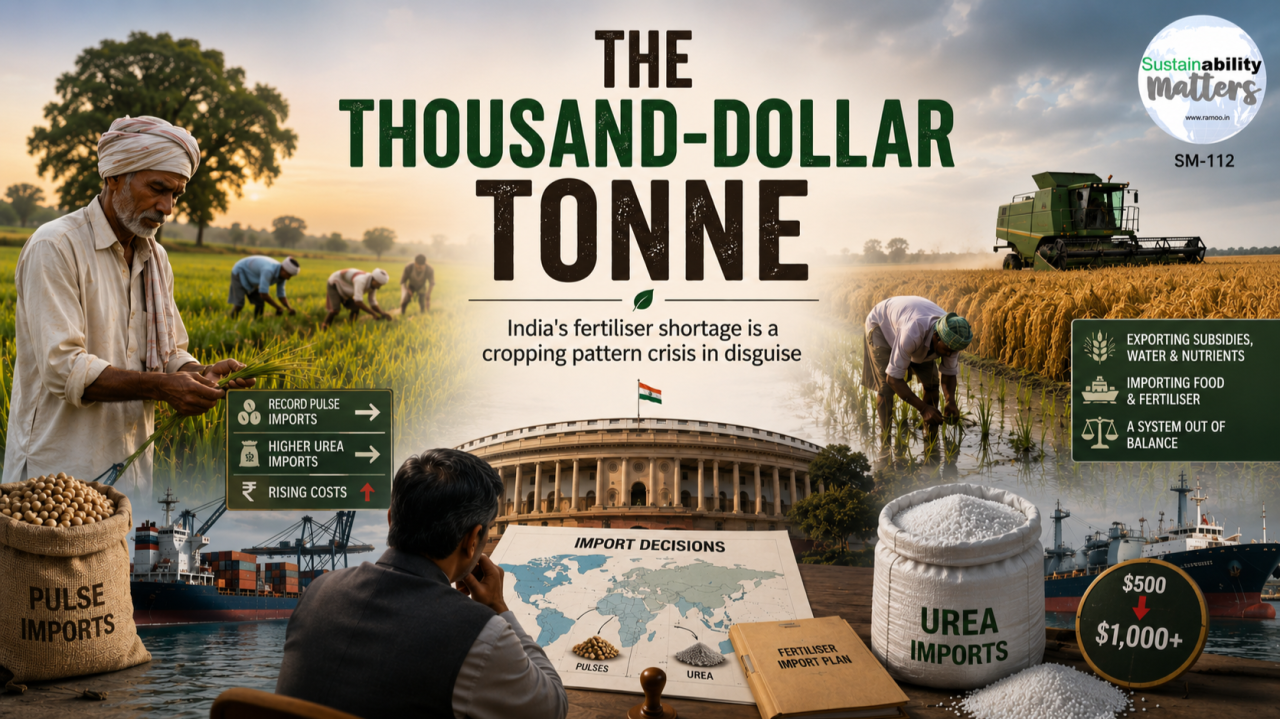
Earlier this month, when bids came back for India’s latest urea import tender, most clustered around $1,000 a tonne. One bid hit $1,136. The previous tender — just a few months earlier — had cleared at $500. The world’s largest urea importer was being asked to pay double, and had little choice but to accept, because Indian gas-based urea plants were throttling production as LNG flows through the Strait of Hormuz seized up, and the kharif sowing season was knocking at the door.
The fertiliser ministry’s scramble is being framed as a Middle East story. It is partly that. But there is something deeper — and uglier — running underneath, that almost no one in policy is willing to look at directly: India’s fertiliser shortage is, in significant part, a cropping pattern crisis dressed up as an energy crisis.
To see this, you have to add up three numbers that nobody adds up together.
The arithmetic on no one’s desk
In FY 2024-25, India imported a record 73.4 lakh tonnes of pulses worth $5.47 billion. This is the headline number that has been written about. What has not been written about is what those imports represent in agronomic terms.
The 73.4 lakh tonnes correspond to roughly 9.3 million hectares of pulse cultivation that India effectively outsourced — to Canada, Russia, Australia, Mozambique, Tanzania, Myanmar. About a third of India’s entire current pulse area.
Pulses, unlike cereals, fix nitrogen biologically. They pull it out of the air and put it into the soil through their root nodules. A typical Indian pulse leaves behind 30-55 kg of nitrogen per hectare for the next crop in the rotation — for free, no fertiliser bag, no subsidy, no tonne of LNG burnt to make ammonia. Indian agronomy textbooks have been saying this for fifty years.
Do the multiplication. 9.3 million hectares × 35 kg N/ha (a conservative residual figure) = 3.28 lakh tonnes of nitrogen. To replace this with urea, India would need to import or produce roughly 7.1 lakh tonnes of additional urea — about 10% of its annual urea import volume.
At normal global urea prices ($385/tonne), that is a hidden cost of roughly ₹2,280 crore on top of the visible pulse import bill. At current Hormuz-disruption prices ($1,000/tonne), it rises to ₹5,920 crore.
The pulse import bill therefore understates the true import burden by 5-13 per cent. Worse, the two costs are correlated — the same Middle East shock that spikes urea prices is partly downstream of the import dependency that pulse-import-driven N substitution has helped create.
The Hormuz multiplier
This is where the cropping pattern crisis and the energy crisis collide. India’s urea production is heavily LNG-dependent. Most of that LNG transits the Strait of Hormuz. When Hormuz shipping seizes up, two things happen simultaneously: global urea prices spike, and Indian gas-based urea plants curtail their own output for lack of feedstock. India then has to import more urea to fill the gap, at exactly the moment when imported urea is most expensive.
So in the current moment, India is paying double for the urea it imports, while simultaneously importing record quantities of pulses, the domestic cultivation of which would have reduced urea demand in the first place. Every tonne of pulse we did not grow at home translated into a tonne of urea we now have to import at twice the price.
This is not a hedging strategy. This is structural exposure compounding itself.
What we are exporting without realising
The reverse side of the same coin is more striking. While we have been importing pulses, we have been exporting cereals — rice, in particular — at record volumes. In FY 2024-25, India exported 20.2 million tonnes of rice, the second-highest ever. The Indian Rice Exporters Federation projects 23.5 million tonnes for 2025-26, which would be a new record.
Rice, unlike pulses, is a heavy nitrogen user. Indian paddy receives an average 120 kg of N per hectare, often 150+ in Punjab and Haryana. Each tonne of milled rice exported therefore carries with it roughly 50 kg of embedded nitrogen, accounting for the paddy-to-milled rice conversion.
20.2 million tonnes of rice exports × 50 kg N per tonne = 10.1 lakh tonnes of nitrogen, equivalent to about 22.6 lakh tonnes of urea, embedded in the rice that left Indian ports last year. That is three times the foregone-BNF nitrogen from pulse imports calculated above. In the peak year 2021-22, when wheat and maize exports were also strong, the embedded-N figure was over 32 lakh tonnes of urea-equivalent — nearly half of India’s annual urea import volume.
To repeat: India simultaneously imported 7-10 million tonnes of urea every year while exporting 20+ lakh tonnes of urea-equivalent nitrogen in finished rice form, and paid extra for the substitute N foregone through pulse imports. We are net importers of nitrogen in chemical form and net exporters of nitrogen in finished cereal form.
The conservative estimate of embedded subsidies in India’s exported rice — urea subsidy, free power for groundwater pumping, near-zero-priced canal water, FCI carrying costs — works out to ₹25,000-30,000 per tonne, or roughly ₹50,000-60,000 crore per year. That is more than the entire pulse import bill of ₹45,600 crore.
We have built a trade architecture in which we pay subsidies to grow water-intensive cereals in semi-arid zones, export the cereals with embedded subsidies, and then pay foreign exchange for pulses and urea to fill the soil-nitrogen and protein gaps that the cereal expansion has created.
Why this happens
This is not an accident. It is the cumulative result of policy choices that each look reasonable individually but produce a perverse system in aggregate.
FCI procures over 80 million tonnes of rice and wheat annually under an effective open-ended MSP. Pulses have no equivalent procurement architecture. NAFED-NCCF procurement is thin, episodic, and concentrated in a few states. The cereal farmer has a guaranteed buyer; the pulse farmer takes his chances with the trader.
Urea is the most heavily subsidised input in Indian agriculture — at the farmer’s margin, it is essentially free. A pulse rotation that saves 100 kg of N per hectare on the next cereal crop is invisible in the farmer’s profit-and-loss because that N is not a real cash cost. The biological nitrogen fixation service that pulses provide has no price in the system, so nobody pays for it. The CACP cost-of-cultivation methodology, on which MSP is based, values it at zero.
Rice exports are a foreign-exchange story owned by the Ministry of Commerce. Non-basmati rice generates $4-5 billion in export earnings; basmati another $5-6 billion. These are visible numbers that get celebrated. The hidden costs — embedded subsidies, water table depletion, soil nitrogen drawdown, pulse-import substitution — do not appear on any Commerce Ministry dashboard.
The ethanol push has now added a third layer. Maize area expanded 51 per cent over twenty years; ethanol distilleries now consume 6-7 million tonnes per year. India flipped from being Asia’s top maize exporter to a net importer in 2024 — for the first time since 1999. The ethanol policy is owned by the Petroleum Ministry; its second-order effects on poultry feed costs, maize imports, and foregone pulse area sit with the Agriculture Ministry, which has limited bargaining leverage in the inter-ministerial trade-offs.
And finally, the most politically sensitive zone — the Punjab-Haryana paddy belt — is structurally untouchable. The most water- and N-stressed paddy production is also the most political. Every attempt at crop-zone-differentiated MSP has been killed before it reached the cabinet.
What the farmer cannot fix
A pulse farmer in Bundelkhand or Vidarbha or northern Karnataka, looking at the relative economics of his options, makes an entirely rational decision. He sees cereal MSP available and procured; free or near-free electricity for groundwater pumping; urea at a fraction of its economic cost; no procurement guarantee for pulses; and a history of imports flooding the market just as he is about to harvest.
He chooses cotton, soybean, sugarcane, banana — anything but pulses. He is responding correctly to the price signals the system is sending him. The system is sending the wrong signals.
This is why the Mission for Aatmanirbharta in Pulses, announced in Budget 2025 with ₹1,000 crore over six years, is unlikely to deliver. ₹1,000 crore against the relative-economics distortion produced by lakhs of crores of cereal and fertiliser subsidies is not a mission; it is a gesture.
What could actually be done
A few things would move the needle, in declining order of feasibility.
One, a predictable sliding-scale import duty on pulses. Duty-free when domestic prices breach 25 per cent above MSP; restored to 30-50 per cent when prices fall below MSP. This creates a price floor for the farmer without triggering inflation panics. The current on-again-off-again binary is the worst possible design — it transfers maximum uncertainty to the farmer.
Two, dedicate ₹5,000 crore to a Mission Rice-Fallow Pulse Revolution. India has 5-6 million hectares of rice-fallow land in Bihar, eastern UP, Odisha, West Bengal, Jharkhand, and Chhattisgarh that lies idle every rabi season. ICAR-IIPR has had short-duration pulse varieties ready for this land since at least 2010. The bottleneck has been FPO-led extension and procurement infrastructure — solvable problems. This is the no-regret option. No cereal output lost. 4-5 million tonnes of additional pulse production possible. About $3.3 billion in pulse imports eliminated. And the residual nitrogen benefits the next kharif rice crop, reducing urea demand on top of that. This proposal has been on every official pulses report since 2007. It has not been implemented.
Three, internalise the BNF as a ecosystem service in CACP’s cost-of-cultivation methodology. A direct benefit transfer of ₹2,000-3,000 per hectare for pulse cultivation, monetised against avoided urea import-parity prices, would correct the relative-economics distortion. The fiscal cost is modest — ₹6,000-8,000 crore on full rollout, or roughly what we just spent extra on a single $1,000-a-tonne urea tender.
Four, re-pace the ethanol-blending programme. The E20 target was set when domestic maize was surplus; it is now driving maize imports and feed-price inflation. A phased adjustment to E15 with feedstock diversification toward damaged-grain ethanol and second-generation cellulosic pathways would relieve pressure on the maize-pulse-feed system without abandoning the energy-security goal.
One crisis, three faces
If you read the morning newspapers in isolation, you would see three separate stories: the fertiliser shortage and the $1,000-a-tonne urea tender; the record pulse imports putting downward pressure on farm prices; and the record rice export forecast for 2025-26. These look like three different stories from three different ministries.
They are not three stories. They are one story.
India has built a cropping pattern in which it imports pulses because the economics do not support domestic pulse cultivation, exports rice because the economics over-support cereals, and pays for it all by importing urea to compensate for the soil nitrogen the absent pulses would have fixed. Each policy in isolation has a plausible justification. The system in aggregate is structurally absurd.
The current Middle East shock has, for once, made this absurdity visible by forcing the costs to spike all at once. Indian gas-based urea plants are throttling. Tender prices have doubled. Farmers are nervous about kharif urea availability. And in the background, pulse imports continue at record levels and rice exports are projected to set another record.
If this shock forces the policy system to actually look at the cropping pattern — to ask, finally, why we are importing pulses to grow cereals to export them while importing urea to substitute for the nitrogen the pulses would have fixed — then the thousand-dollar tonne will have produced more useful policy thinking than the entire decade of pulse missions before it.
That would be a small consolation. But it would be more than we are currently getting.
Note on sources and method. All trade figures are from DGCI&S, the Ministry of Consumer Affairs, iGrain India, IPGA, USDA-FAS, and UN Comtrade. Production figures are from the Directorate of Economics and Statistics, GoI. BNF residual values follow ICAR-IIPR rotational-trial literature; N application intensities follow CIMMYT and FAI averages for Indian conditions. The detailed analytical note underlying this article — “India’s Pulse Imports, Cereal Expansion, and the Hidden Nitrogen Account, 2004-05 to 2024-25” — is available from the author at the Centre for Sustainable Agriculture, Hyderabad.
Recent Comments