

A Journey Through Plasticulture
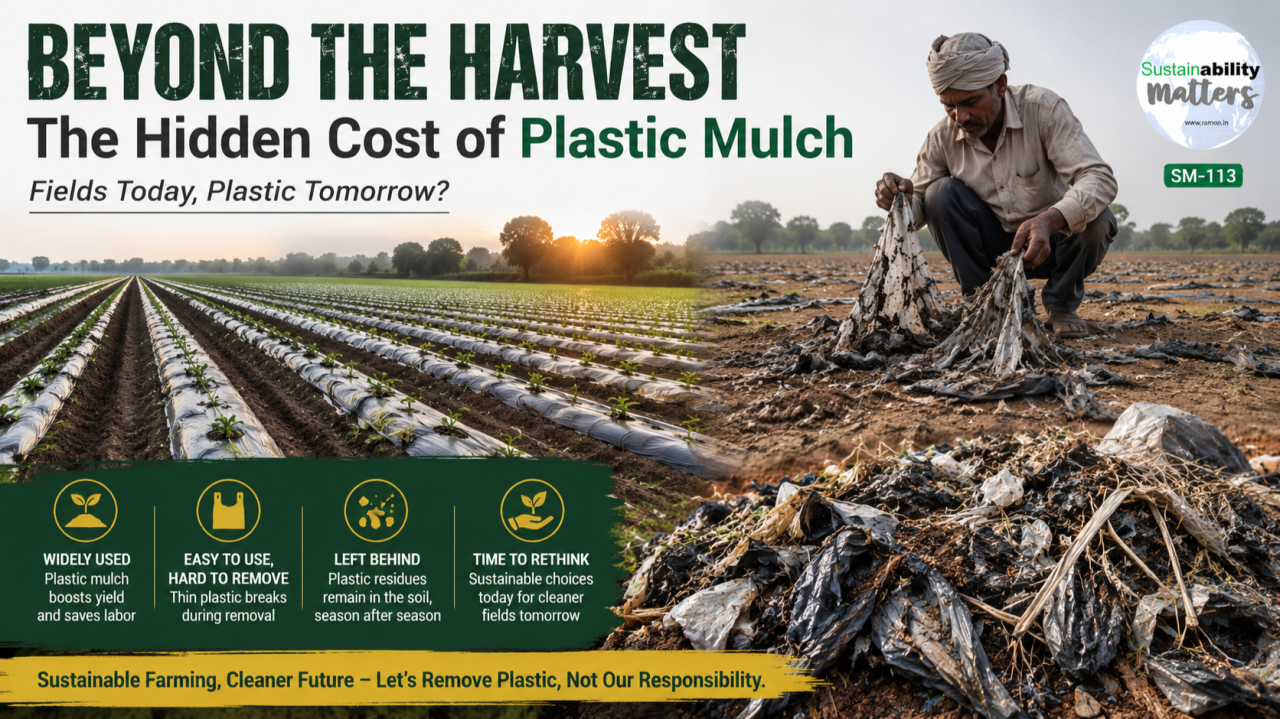
Recently, while travelling through the Melukote (Melkote) region of Pandavapura Taluk in Mandya district, Karnataka, I was struck by the vast stretches of vegetable, flower, and fruit crops covered with plastic mulch. It reminded me of similar scenes I had witnessed earlier in the horticultural belts of Kadapa district in Andhra Pradesh. Across these landscapes, the now-familiar silver-black sheets stretched across field after field, reflecting sunlight and giving the farms a neat, modern, almost futuristic appearance.
From the road, the picture seemed reassuring. The fields looked clean, productive, and well-managed. Plastic mulch has become a symbol of efficient horticulture—saving water, suppressing weeds, and helping farmers increase yields.
But the picture changed the moment I stepped out of the car and walked into the fields.
Along the bunds lay heaps of discarded plastic mulch removed after harvest. Torn fragments were scattered across the soil. Pieces of brittle film protruded from cultivation beds, half-buried and impossible to collect completely. In some places, farmers had piled the waste into mounds; in others, they were burning it to get rid of an increasingly troublesome burden.
The contrast was striking. The same plastic sheets that looked clean and shiny while serving the crop had become a waste problem the moment the season ended.
Standing there, a question kept returning: What are we putting into our fields today, and what will remain in them tomorrow?
Plastic mulch undoubtedly delivers immediate benefits—higher yields, lower labour costs, and significant water savings. Yet every season leaves behind traces of the material in the soil. What begins as a solution for productivity may gradually become a challenge for soil health, waste management, and long-term sustainability.
This article explores that dilemma. It examines why plastic mulch has spread so rapidly across South Indian agriculture, the economic benefits it offers farmers, and the emerging evidence that the technology may be leaving behind a legacy of microplastics in the very soils it was meant to protect.
1. The Quiet Spread of Plasticulture
A thin sheet of black or silver-black polyethylene has become as common in South Indian vegetable and flower fields as the drip line beneath it. Mulch film has moved out of polyhouses and onto open fields growing tomato, chilli, capsicum, watermelon, and cut flowers. Three pressures explain why adoption has been fastest in Telangana, Andhra Pradesh, Tamil Nadu and Karnataka: water scarcity (falling water tables make any evaporation-cutting technology attractive), and labour(weeding is the costliest operation in vegetable cultivation, and opaque film suppresses 90-100% of weeds without herbicides).
Policy reinforces the trend. Drip irrigation – mulch’s natural companion – attracts central assistance of 55% for small and marginal farmers and 45% for others under the Per Drop More Crop scheme (now under RKVY), with state top-ups. When the irrigation backbone is subsidised, adding mulch is a low-risk incremental decision. This article takes the agronomy and economics seriously – mulch genuinely makes money on the right crop – while insisting on a third column in the ledger: the soil.
2. Why Farmers Use Plastic Mulch
The agronomic case is real: moisture conservation (40-60% water saving with drip), weed suppression without herbicides, better fertiliser-use efficiency through fertigation, early establishment and root-zone temperature control, higher yields and cleaner produce, and lower, more predictable labour. Benefits are greatest in high-value, wide-spaced, longer-duration crops where the film cost spreads over a large revenue base – tomato, chilli, and capsicum among vegetables; marigold, chrysanthemum, rose, and gerbera among flowers; plus watermelon, cucumber, and mulberry. Tomato is the textbook case: a 30-40% yield lift with cleaner fruit and less soil-borne rot. Chilli’s 6-8 month duration lets a single film serve the whole crop.
3. Economics: Five Crop Budgets (2025-26)
The table below gives indicative one-acre net returns for South Indian conditions on 2025-26 prices. Cost building blocks: mulch film (25-30 micron LLDPE/LDPE) at roughly Rs 135-200/kg, about Rs 18,000-28,000 per acre; bed preparation Rs 4,000-7,000; laying Rs 3,000-6,000; drip Rs 45,000-60,000 (heavily subsidised, treated here as an installed shared asset); rural wages Rs 350-500/day. The benefit-cost ratio is on the incremental mulch investment. Net returns are dominated by market price, which is volatile – so read these as a framework to re-cost locally, not fixed figures.
A few patterns stand out. Tomato gives the strongest incremental return – a 30-40% yield lift plus cleaner fruit and less rot – but is also the most price-exposed: at a Rs 6/kg glut the entire margin can vanish, mulch or not. Chilli’s long 6-8 month duration lets one film cover the whole crop, spreading its cost and maximising the weed-control payoff. Marigold and chrysanthemum justify mulch on flower grade and a long picking window, with chrysanthemum benefiting most from steadier root-zone moisture. Watermelon is short-duration but wide-spaced and high-value, so even a single-season film pays in sandy summer soils. The common thread: mulch rewards crops where revenue per acre is high enough to absorb Rs 20,000+ of film several times over.
When mulch becomes uneconomical: short-duration or low-spacing crops (a full film for a 50-70 day crop), low-value crops and broad-acre cereals/pulses that cannot absorb Rs 20,000+ of film, areas with no disposal system (where removal and contamination are real unpriced costs), and periods of high polymer prices that erode the BCR.
4. The Hidden Environmental Cost
The thin films that make mulch cheap (20-30 micron) are the hardest to recover. At crop end, brittle, soil-coated film tears into shreds; fragments stay buried at bed edges and in the plough layer, and the load accumulates season after season because the material does not meaningfully biodegrade. South India’s climate accelerates this: summer soil surfaces reach 50-60 C and UV on the Deccan is intense, so polyethylene photo-oxidises, embrittles, and fragments into microplastics. The hottest, driest tracts – Rayalaseema, the Telangana plateau, and northern Karnataka – are exactly where water scarcity has driven the fastest adoption, so the highest-uptake zones overlap with the highest-degradation zones.
The degradation feedback
Thin film (cheap) → tears on removal → fragments left in soil → 50-60 C heat + intense UV → photo-oxidation and embrittlement → mechanical fragmentation → microplastics accumulating in the plough layer, season after season.
5. Microplastics: The Emerging Soil Problem
Microplastics are plastic particles under 5 mm. Mulch film is among the most direct in-field sources, since the plastic is spread on the soil and left to weather for a whole crop. Other pathways – contaminated compost, wastewater irrigation, atmospheric deposition, dumpsite runoff – overlap, but mulch is the one farmers control most directly. The Indian evidence base is thin but consistent: mulched fields carry more microplastics than unmulched fields, and polyethylene dominates.
- The 2022 Toxics Link study “Plastic Mulching: Microplastics in Agricultural Soils” (analysis at Manipal Academy of Higher Education) sampled mulched, unmulched, and dumpsite soils in Karnataka and Maharashtra. Microplastics appeared in every sample, far higher in mulched soils.
- Peer-reviewed 2025 work on coastal Karnataka again found higher microplastic loads in mulched (watermelon) than unmulched (rice) fields, polyethylene dominant, and flagged that microplastics can adsorb trace metals and alter their uptake. Baseline surveys detected particles through the profile to 30 cm depth.
6. Impacts on Soil Biology and Health
Microplastics interact with the organisms that make soil fertile; effects depend on polymer, particle size, dose, and exposure. A global meta-analysis (781 observations, 92 publications) found microplastics increased microbial biomass while reducing the growth and reproduction of soil fauna (nematodes, springtails, earthworms). Smaller polyethylene particles can reduce the Shannon diversity of bacteria, fungi, and protists. For earthworms – the keystone soil engineers – polyethylene can alter gut microbiota and induce oxidative stress, though results vary and some short, realistic exposures show limited harm; encouragingly, earthworms can partly buffer microplastic stress on the wider microbiome. Through these changes, microplastics can influence nutrient cycling, carbon sequestration, aggregation, and water retention. None of this collapses yield in one season – which is exactly why it is dangerous: a slow erosion of the soil’s biological capital, easy to ignore until expensive to reverse.
7. Can Microplastics Enter the Food Chain?
This is the question farmers and consumers ask first, and it is where honesty about the limits of evidence matters most. The findings fall into three tiers.
- Established. Microplastics are present in agricultural soils, including Indian farm soils, at higher levels in mulched fields; plant roots can take up the smallest particles under experimental conditions; humans are exposed via water, food, and air, and microplastics are documented in the human body.
- Emerging. Root-to-shoot-to-fruit transfer has been shown in lab and greenhouse studies for some crops, and microplastics can act as vectors for trace metals and pesticides, altering their bioavailability – but field-scale, real-diet quantification is limited.
- Research gaps. How much produce-microplastic actually comes from in-field mulch versus other sources; realistic dietary exposure attributable to mulched agriculture; and India-specific crop, soil, and climate data, since most uptake studies are from elsewhere.
The responsible reading: a plausible, partly-evidenced pathway from mulch film to soil to crop to human exposure exists, but the quantitative food-safety risk from mulch specifically is not yet established – a reason for precaution and research, not for either alarm or complacency.
8. The Waste Management Crisis
The biggest gap is at crop end. India has almost no system to collect, transport, and recycle used mulch film. No collection channel exists; much film is burned (toxic) or dumped at field edges – and the dumpsite microplastic levels nearly double those of mulched fields show how damaging that is. Recycling barriers are severe: mulch film arrives soil-contaminated, thin, and low-grade, so reprocessing is costly and recyclers have little incentive. No reliable national tonnage figure exists – itself part of the problem – but at 120-160 kg of film per acre per crop, even a few hundred thousand mulched acres across the three states imply tens of thousands of tonnes of waste a year, almost all unmanaged. Quantifying this is an urgent first task.
9. Farmer Perspectives
Farmers are pragmatic and divided. They value water savings (decisive where borewells fail), labour reduction (often the biggest draw), and the visible jump in marketable yield and quality. They worry about disposal cost and effort, plastic visibly accumulating in their best fields, rising and volatile film prices, and – among a growing natural-farming-oriented minority – long-term soil harm. The takeaway: farmers will adopt alternatives readily if those alternatives match plastic on water, weeds, and labour at comparable cost. The burden is on research, industry, and policy to make that true – not on the farmer to absorb a loss for a benefit they cannot see in this season’s accounts.
10. Alternatives to Conventional Plastic Mulch
No single alternative yet matches polyethylene on cost, weeds, water, and convenience together, but a portfolio exists. Organic mulches (paddy straw, sugarcane trash, coir, groundnut haulms) conserve moisture and, crucially, add organic matter and feed soil biology – the opposite of plastic – though they suppress weeds less and need labour to apply. Living mulches and cover crops cover soil, fix nitrogen, and leave no residue, but demand management skill. Biodegradable films (PBAT, PLA) remove the disposal problem but cost more, vary in performance, and – importantly – still fragment into microplastics and can disturb soil fauna (PLA disrupted earthworm gut microbiota more than polyethylene in some studies): “biodegradable” is not automatically “benign,” and Indian-condition standards are essential. Paper mulch, natural-fibre mats (coir, jute), and agroecological system design round out the options.
11. Policy Recommendations
The goal is not to ban a technology that saves water and raises incomes, but to internalise its hidden cost. Responsibilities are shared:
1. Government: bring mulch film under Extended Producer Responsibility so makers finance collection and recycling; build village/FPO collection points and dedicated agri-film recyclers; mandate a minimum film thickness (recoverable, recyclable); set biodegradable-mulch standards verified under Indian conditions; and condition mulch/drip subsidies on collection compliance while incentivising non-plastic alternatives.
2. Research institutions (ICAR, SAUs, NIPHM): run long-term field studies on accumulation, soil-biology effects, and crop uptake in Telangana/AP/Karnataka – the India-specific data gap is the single biggest weakness; standardise sampling; and validate alternatives that match plastic on cost and performance.
3. Input companies: make recoverable film, invest in take-back, and develop verified biodegradable products rather than unproven “eco” claims.
4. FPOs: aggregate the fix farmers cannot manage alone – collective film collection, mulch-laying and removal machinery on custom hire, links to recyclers, and pilots of organic and biodegradable alternatives at scale.
12. Conclusion
Plastic mulch has earned its place in South Indian fields: better water-use efficiency, lower labour, and higher profitability in high-value horticulture, with farm-level economics that remain attractive at 2025-26 prices. None of that should be wished away. But the same films, fragmenting under 50-60 C heat and intense UV, are accumulating as microplastics in the very soils they protect – now confirmed, not merely feared, by Karnataka and Maharashtra field studies showing higher loads in mulched soils with polyethylene dominant. These particles affect soil structure, water movement, microbial diversity, and fauna, with a plausible if unquantified pathway into food, and India’s near-total absence of collection turns a manageable problem into an accumulating one. Future policy must add a third column to a ledger that holds only yield and net return: soil health and long-term sustainability. The challenge is not using plastic mulch a little better – it is designing systems that conserve water and lift productivity without leaving a legacy of plastic in the ground. The water and the yield are worth keeping. The plastic in the soil is not.
Selected Sources
1. Toxics Link & Manipal Academy of Higher Education (2022). Plastic Mulching: Microplastics in Agricultural Soils – Karnataka & Maharashtra.
2. Environmental Geochemistry and Health (2025). Microplastic and trace-element contamination in coastal agricultural soils of southern India (mulched vs unmulched, Karnataka).
3. Environmental Monitoring and Assessment (2025). Baseline microplastic contamination in agricultural soils, coastal Karnataka and Goa.
4. Global meta-analysis (2025). Effects of microplastics on soil microbial diversity and community structure (781 observations, 92 studies).
5. ScienceDirect (2023-2025). PE and PLA microplastics, earthworm gut microbiota and soil microbiome dynamics.
6. Government of India / PIB. Per Drop More Crop (PMKSY / RKVY) micro-irrigation subsidy norms (55% small/marginal, 45% others).
7. Market price references (2025-26): IndiaMART and Agriplast mulching-film listings; India drip-irrigation cost-per-acre estimates.
Enterprise budgets are indicative one-acre estimates on 2025-26 prices and should be re-costed locally; net returns are dominated by volatile market prices. BCRs are on the incremental mulch investment, a
Recent Comments